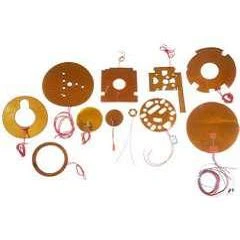
Product Description
Our industrial Resistance Heater is engineered based on the fundamental Joule's Law of Heating, which quantifies thermal energy generation as Q = I²Rt (where Q = heat, I = current, R = resistance, t = time). This scientific principle enables the conversion of electrical energy into thermal energy through electron-atom collisions in high-resistance materials, delivering precise and controllable heating performance for industrial applications.
The core heating element utilizes two high-performance alloy materials: nickel-chromium (NiCr) alloy and iron-chromium-aluminum (FeCrAl) alloy. NiCr alloy, recognized as the "premium choice" in heating materials, offers exceptional high-temperature strength (sustaining 1000℃-1200℃), excellent oxidation resistance, and stable radiation characteristics, making it ideal for precision heating scenarios. FeCrAl alloy, the cost-effective alternative, boasts high resistivity, low temperature coefficient of resistance, and a maximum operating temperature of up to 1400℃, suitable for high-efficiency heating requirements. Both alloys are processed via advanced laser cladding or 3D printing (SLM/DMD) technologies, minimizing porosity and oxide content in the heating layer while enabling customization on metal, ceramic, glass, or plastic substrates.
A key advantage of our Resistance Heater lies in its dual heating mode compatibility. Direct resistance heating achieves ultra-high energy efficiency by passing current directly through conductive workpieces (e.g., metal billets for forging), eliminating heat transfer losses. Indirect resistance heating, via dedicated heating elements, offers broad versatility for heating non-conductive materials (e.g., plastics, insulators) through convection, radiation, or conduction. Additionally, the product adheres to the latest EU ecodesign rules, featuring optimized low-power modes to reduce standby energy consumption and greenhouse gas emissions.
Features
Safety & Reliability
Equipped with IP54+ enclosure protection, overload/short-circuit protection, and insulation resistance testing to prevent leakage hazards. Certified to UL 499, CE, and GB 3836 standards, ensuring safe operation in explosive and harsh industrial environments.
Energy Efficiency
High thermal conversion efficiency (up to 95% for direct heating mode) and compliance with EU energy consumption limits for low-power modes, reducing long-term operational costs significantly.
Durability
The alloy heating elements form a dense oxide protective layer, resisting corrosion and oxidation. Test data shows resistance drift ≤5% after 1000 hours of continuous operation, with a typical service life of 8000+ hours under standard conditions.
Precision Control
Resistance value is minimally affected by temperature changes, enabling accurate temperature regulation (±1℃) and stable heat output, suitable for precision manufacturing processes.
Versatile Design
Available in various configurations (infrared tube, heating tape, strip heaters) and customizable dimensions, adapting to flat, cylindrical, or irregular workpieces.
Environmental Compliance
Lead-free manufacturing process meets RoHS requirements, with no harmful emissions during operation, aligning with global environmental protection standards.
Applications
Major Industries
1.Petrochemical & Oil Gas
2.Food Processing & Beverage
3.Automotive Manufacturing
4.Electronics & Semiconductor
5.Aerospace & Aviation
6.Pharmaceutical & Medical Equipment
7.Material Handling & Heat Treatment
8.Plastics & Rubber Processing
Typical Use Cases
•Metal billet heating prior to forging/welding (direct heating mode)
•Pipe freeze protection in cold storage facilities (heating tape application)
•Infrared heating for plastic film drying and curing processes
•Precision temperature maintenance in semiconductor fabrication chambers
•High-temperature annealing of metal components in industrial furnaces
•Food sterilization equipment heating (complies with food contact safety standards)
•Hazardous area heating in petrochemical refineries (explosion-proof design)
Why Choose Our Resistance Heater?
Laser cladding parameters (3.0-10kW power, 5-10mm/min scanning speed) ensure uniform heating layer deposition with porosity ≤2%. Heating power ranges from 100W to 400W, voltage compatibility (120V/240V/380V), and surface temperature control (200℃-400℃) meet diverse industrial specifications.
Undergoes 6 strict safety tests (enclosure protection, insulation performance, temperature rise, explosion-proof, electrical safety, and protective device verification) before delivery. FM approval for fire safety and UL 1203 certification for hazardous locations provide dual safety guarantees.
15-20% lower energy consumption compared to standard resistance heaters (per EU ecodesign savings data). Extended service life reduces replacement frequency, and readily available spare parts minimize downtime costs.
Adopts GB/T 1234-2012 standard high-resistance electric heating alloys, with 100% incoming material inspection and full-process quality tracking under ISO 9001:2015 certification. Batch consistency rate reaches 99.8%.
15+ years of industrial heater manufacturing experience, with a 10,000㎡ production base and annual capacity of 500,000 units. Offers free technical consultation, custom design services (7-10 day lead time for prototypes), and 24/7 after-sales support. Global logistics network ensures on-time delivery to 50+ countries.
FAQ
Hot Tags: resistance heater, China resistance heater manufacturers, suppliers, factory, Cartridge Heater, Immersion Heater, industry heaters, Flexible Heater, Resistance Heater