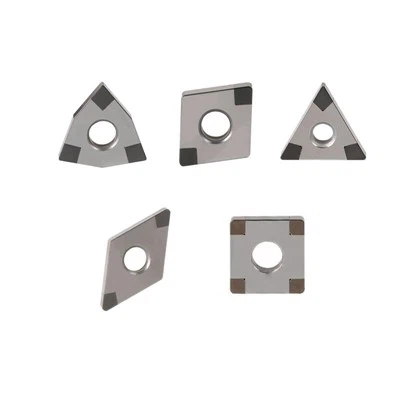
Product Introduction
Grade GC1025
Ideal for general-purpose grooving and cutoff operations on carbon steel and alloy steel. This grade features a wear-resistant carbide substrate combined with a TiAlN coating, ensuring balanced toughness and hardness for prolonged tool life. It performs reliably in both continuous and light interrupted cutting, making it a versatile choice for most steel machining scenarios.
Grade GC2030
Designed for stainless steel and high-temperature alloys. Its micrograin carbide structure (with grain size as fine as 0.5-1μm) enhances hardness and wear resistance, while the CrN-based coating provides superior resistance to built-up edge (BUE) and thermal shock. Even in high-heat environments (exceeding 800°C), this grade maintains sharp cutting edges, reducing the frequency of insert replacement.
Grade GC3015
Specialized for non-ferrous materials such as aluminum, copper, and their alloys. The uncoated ultra-fine carbide substrate (grain size <0.3μm) offers excellent chip control and surface finish, preventing material adhesion- a common issue when machining soft non-ferrous metals. It also minimizes burr formation, reducing the need for post-machining deburring.
Cutting Conditions
Optimized cutting parameters vary by grade and workpiece material, with the following ranges recommended for optimal results (adjust based on specific machine capabilities and part requirements):
Cutting Speed (Vc):
● 80-200 m/min for carbon steel (GC1025): Lower speeds (80-120 m/min) for high-hardness carbon steel (HRC 30-40); higher speeds (120-200 m/min) for low-hardness carbon steel (HRC <20).
● 50-120 m/min for stainless steel (GC2030): Stainless steel's low thermal conductivity requires slower speeds to avoid overheating; use 50-80 m/min for austenitic stainless steel (e.g., 304, 316) and 80-120 m/min for ferritic stainless steel (e.g., 430).
● 150-300 m/min for non-ferrous materials (GC3015): Aluminum (180-300 m/min) due to its high machinability; copper (150-220 m/min) as it is slightly harder than aluminum and generates more friction.
Feed Rate (fz): 0.03-0.15 mm/rev. For precision grooving (tolerance ±0.01 mm), use 0.03-0.08 mm/rev; for general cutoff operations, 0.08-0.15 mm/rev balances efficiency and surface quality.
Depth of Cut (ap): Up to 5 mm for standard inserts. For deeper grooving (5-10 mm), contact our team for custom inserts with reinforced structures to prevent breakage.
Coolant: Recommended for high-speed operations and heat-sensitive materials. Use water-soluble coolant (concentration 5-10%) for steel and stainless steel to reduce tool wear; for non-ferrous materials, mineral oil-based coolant can further improve surface finish. Dry cutting is acceptable for low-speed (≤80 m/min) operations with GC1025 and GC2030.
Features
Precision Ground Geometry: Each insert undergoes a 5-step grinding process (rough grinding, fine grinding, lapping, edge honing, and inspection) to ensure tight tolerances: cutting edge straightness ≤0.002 mm, rake angle tolerance ±0.5°, and clearance angle tolerance ±0.3°. This precision guarantees consistent groove dimensions (tolerance ±0.005 mm) and clean cutoff surfaces (Ra ≤1.6 μm), minimizing post-machining finishing work (e.g., grinding, polishing) and reducing production costs.
Advanced Coating Technology: The proprietary multi-layer coatings (TiAlN for GC1025, CrN for GC2030) are applied via physical vapor deposition (PVD) at 500-600°C, ensuring strong adhesion to the carbide substrate. These coatings reduce friction (coefficient of friction ≤0.3 against steel), dissipate heat efficiently (thermal conductivity increased by 20% compared to uncoated inserts), and resist chemical reactions (e.g., oxidation, corrosion) with workpiece materials. This extends tool life by up to 30% compared to standard inserts in the market.
Enhanced Chip Breakers: Strategically designed chip breaker grooves (with variable depth and angle) facilitate smooth chip flow. For grooving operations, the curved chip breaker guides chips upward and away from the groove; for cutoff operations, the straight chip breaker ensures chips break into small, manageable pieces (length ≤10 mm), preventing chip clogging in deep grooves or narrow cutoff areas. This feature is critical for maintaining process stability and reducing machine downtime (e.g., time spent clearing chip jams).
Versatile Mounting Options: Compatible with most standard grooving and cutoff tool holders (e.g., Sandvik Coromant, Kennametal, Iscar) with ISO standard interfaces. The inserts feature a universal clamping design (with a central hole and locating tabs) that ensures easy installation and secure positioning, eliminating the need for specialized equipment. This flexibility allows integration with existing machining setups (CNC lathes, automatic turning centers) without additional investment.
High Impact Resistance: The carbide substrates are engineered with a balanced ratio of tungsten carbide (90-92%) and cobalt (8-10%)- the cobalt acts as a binder to enhance toughness. This composition allows the inserts to withstand sudden load changes (e.g., when machining parts with irregular surfaces) without chipping or breaking, making them suitable for interrupted cutting operations common in batch production of complex parts.
Applications
Our Grooving Off Inserts excel in a wide range of industrial machining scenarios, delivering consistent performance and efficiency:
Automotive Manufacturing
Used for grooving axle shafts (carbon steel, GC1025), gear hubs (alloy steel, GC1025), and brake components (cast iron, compatible with GC1025 with adjusted cutting speed). In mass production (e.g., 10,000+ parts per batch), the inserts' long tool life reduces tool change frequency, increasing production line throughput by 15-20%.
Aerospace Engineering
Ideal for precision cutoff and groove machining on turbine blades (Inconel 718, a high-temperature alloy, GC2030), aircraft fasteners (titanium alloy, compatible with GC2030 with coolant), and hydraulic system parts (stainless steel 316, GC2030). The inserts' ability to maintain tight tolerances (±0.003 mm) meets the aerospace industry's strict quality standards (e.g., AS9100).
Electronics Industry
Perfect for creating precise grooves on aluminum heat sinks (GC3015)- the uncoated substrate prevents aluminum adhesion, ensuring the heat sink's fins have a smooth surface (Ra ≤0.8 μm) for optimal thermal dissipation. It is also used for machining copper connectors (GC3015) and sensor housings (aluminum alloy, GC3015), ensuring component fit (clearance ≤0.01 mm) in electronic devices.
General Engineering
Suitable for batch production of shafts (carbon steel, GC1025), pipes (stainless steel, GC2030), and cylindrical parts (brass, GC3015) across various materials. It supports both CNC lathes (e.g., Haas ST-20, Mazak Quick Turn) and automatic turning centers (e.g., Citizen Cincom), making it a go-to choice for small to medium-sized manufacturing facilities.
FAQ
Hot Tags: grooving off insert, China grooving off insert manufacturers, suppliers, factory, Poly Crystalling Diamond Insert, Grooving Off Insert, insert, Insert for Drilling, Carbide Coated Insert for Turning, Cubic Boron Nitride Insert