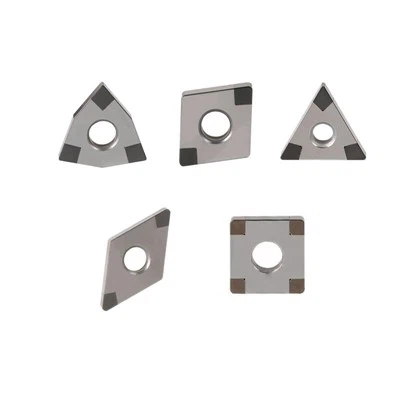
Product Introduction
Grade (Material)
VCMT
Ideal for finishing non-ferrous metals (e.g., aluminum, copper). Features high diamond concentration (90%+) to deliver superior surface finish, making it perfect for precision components requiring minimal roughness.
VNGA
Balances wear resistance and toughness. Designed for semi-finishing operations on aluminum alloys, copper, and light non-ferrous metals, it withstands moderate cutting forces while maintaining dimensional accuracy.
TCMT
Enhanced with a cobalt binder (10-15% content) to boost durability. Specifically engineered for roughing operations on abrasive materials, such as fiber-reinforced plastics (FRP), composites, and wood-based panels, where tool wear is a primary concern.
TNMA
Optimized for high-speed machining (HSM) of non-ferrous alloys. Its fine-grain diamond structure (2-5 μm) enables stable performance at elevated cutting velocities (up to 3,000 m/min), reducing cycle time while extending tool life.
Chipbreaker
Each PCD insert is equipped with a precision-engineered chipbreaker, designed to address common challenges like chip clogging, vibration, and burr formation. Our chipbreaker options include:
VCMT (Sharp Edge Chipbreaker)
Features a narrow, sharp groove for finishing operations. Minimizes burrs on soft materials (e.g., aluminum, brass) and ensures clean chip evacuation, critical for maintaining surface quality in precision parts (e.g., automotive engine components).
VNGA (Curved Groove Chipbreaker)
Boasts a smooth, curved channel that prevents chip accumulation during medium-load machining. Ideal for copper alloys and light alloys, it reduces cutting forces and lowers the risk of tool chipping.
TCMT (Stepped Groove Chipbreaker)
Incorporates a multi-stepped design to break chips into small, manageable fragments. Perfect for roughing abrasive materials (e.g., fiberglass, carbon fiber composites), it avoids chip wrapping around the tool or workpiece, protecting both the insert and the part.
TNMA (Variable Helix Chipbreaker)
Utilizes a helical groove with varying pitch to reduce vibration in high-speed machining. Specifically suited for thin-walled workpieces (e.g., aerospace components) where vibration can cause dimensional errors, it enhances stability and ensures consistent performance.
Features
Our PCD inserts stand out in the market due to their exceptional performance and versatility, with the following core advantages:
Exceptional Wear Resistance
Leveraging diamond's inherent hardness (up to 8,000 HV), our PCD inserts offer 50–100 times longer tool life compared to carbide inserts when machining non-ferrous materials. This reduces tool change frequency and downtime, lowering overall production costs.
Superior Surface Finish
Delivers ultra-smooth surface quality, with Ra values as low as 0.05 μm. This eliminates the need for secondary polishing operations in applications like automotive transmission parts and electronic components, saving time and resources.
High Thermal Conductivity
Diamond's thermal conductivity (2,000–2,500 W/m·K) is 5–10 times higher than carbide. This efficiently dissipates heat generated during high-speed cutting, reducing workpiece deformation and ensuring consistent dimensional accuracy-critical for tight-tolerance parts (e.g., aerospace components).
Chemical Inertness
Resists chemical reactions with non-ferrous metals (aluminum, copper, magnesium) and non-metallic materials (plastics, composites). This prevents built-up edge (BUE), a common issue with carbide inserts that degrades surface quality and tool life.
Versatile Geometry Options
Available in standard shapes (CNMG, DNMG, RNMG, TNMG) and custom sizes to fit most standard tool holders. This ensures easy integration into existing machining setups, with no need for specialized equipment.
Cost-Effective Performance
While PCD inserts have a higher upfront cost than carbide, their extended lifespan and reduced downtime result in a 30–50% lower per-part machining cost-ideal for high-volume production.
Applications
Our PCD inserts are widely used across industries, thanks to their ability to handle diverse materials and machining requirements:
Automotive Industry:
● Machining aluminum alloy engine blocks, cylinder heads, and transmission housings (using PCD-G1/G4 for high-speed finishing).
● Cutting copper heat exchangers and brass fittings (PCD-G2 for semi-finishing, minimizing burrs).
Aerospace Sector:
● Precision machining of magnesium alloy structural parts and composite aircraft components (e.g., carbon fiber wings) using PCD-G3 (abrasion resistance) and PCD-G4 (high-speed stability).
● Finishing titanium alloy components (compatible grades) for aircraft engines, ensuring tight tolerances (±0.005 mm).
Electronics Manufacturing:
● Cutting copper leads for printed circuit boards (PCBs) and aluminum heat sinks for electronics (PCD-G1 for ultra-fine surface finish).
● Machining plastic injection molds (e.g., ABS, PVC) with PCD-G2, achieving smooth cavities that reduce part defects.
Medical Equipment:
● Finishing polymer components (e.g., polyethylene) for surgical instruments (PCD-G1, ensuring biocompatible surface quality).
● Machining non-magnetic stainless steel parts (compatible grades) for diagnostic devices, avoiding contamination.
General Engineering:
● Processing non-ferrous metals (brass, bronze) for valves and fittings (PCD-G2 for semi-finishing).
● Cutting wood-based composites (e.g., MDF, particleboard) and reinforced plastics (FRP, GFRP) using PCD-G3 (abrasion resistance).
FAQ
Hot Tags: poly crystalling diamond insert, China poly crystalling diamond insert manufacturers, suppliers, factory, Poly Crystalling Diamond Insert, Grooving Off Insert, insert, Insert for Drilling, Carbide Coated Insert for Turning, Cubic Boron Nitride Insert