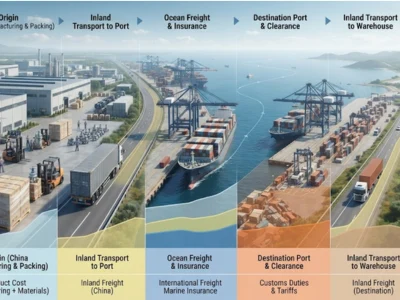
China Plus One Strategy Explained
The China Plus One Strategy is often described as a way to reduce dependence on China by moving part of a company's sourcing or manufacturing activities to another country. That definition is broadly correct, but it doesn't explain the procurement decisions that determine whether geographic diversification actually reduces supply risk.
For industrial buyers, China Plus One is better understood as a supply risk allocation strategy. A company maintains valuable sourcing and manufacturing capabilities in China while developing qualified alternative capacity in another country or region.
Adding another country doesn't automatically create supply chain resilience. The alternative supply base must be independently qualified, capable of scaling production, commercially sustainable, and able to shorten the time required to restore adequate supply after a disruption.
A company can have suppliers in China, Vietnam, India, and Mexico and still depend on the same raw material producers, specialized processors, tooling resources, logistics routes, or upstream component manufacturers. In that situation, supplier count increases while the underlying concentration risk remains.
The real procurement questions are more practical.
Which products should be diversified first? What type of diversification is appropriate? How much alternative capacity is required? Which countries can support the required manufacturing processes? Can new suppliers maintain quality at production volume? Does the long-term landed cost remain competitive? Most importantly, can the new supply structure materially reduce disruption exposure and supply recovery time?
This guide explains the China Plus One Strategy through a structured industrial procurement framework covering supply exposure, disruption impact, product prioritization, risk response, country selection, supplier qualification, production capacity, landed cost, volume allocation, and supplier performance management.

What Is the China Plus One Strategy?
The China Plus One Strategy is a sourcing and manufacturing diversification approach in which a company maintains important supplier relationships or production capabilities in China while developing additional supply capacity in at least one other country.
The objective isn't necessarily to reduce sourcing from China.
It is to reduce excessive dependence on a single geographic supply base while preserving manufacturing capabilities that continue to make China commercially and operationally valuable.
China has developed deep industrial ecosystems across machinery, electronics, industrial components, tooling, precision manufacturing, chemicals, consumer products, and many other industries.
These ecosystems include raw material producers, component manufacturers, specialized processors, tooling companies, engineering teams, testing laboratories, logistics providers, and experienced export manufacturers.
Replacing an entire industrial ecosystem can be expensive, slow, and operationally risky.
China Plus One therefore allows companies to maintain valuable Chinese suppliers while developing additional sourcing or production capacity elsewhere.
For one industrial buyer, this may mean keeping most production in China while qualifying a supplier in Vietnam for selected standardized products. Another company may manufacture complex components in China while establishing regional assembly in Mexico. A third may maintain primary production with Chinese manufacturers while developing qualified emergency capacity in India.
The correct structure depends on product requirements, customer markets, supply risk, production complexity, supplier ecosystems, and procurement economics.
China Plus One vs. Other Supply Chain Diversification Strategies
| Strategy | Primary Objective | China Capacity | Alternative Capacity | Main Procurement Consideration |
|---|---|---|---|---|
| China Only | Operational efficiency | Maintained | None | Geographic concentration risk |
| China Plus One | Geographic diversification | Maintained | One additional country | Supplier qualification and usable capacity |
| China Plus N | Wider geographic diversification | Maintained or reduced | Multiple countries | Coordination and management complexity |
| Nearshoring | Production closer to end markets | Maintained or reduced | Regional capacity | Logistics and supplier ecosystem maturity |
| Reshoring | Return production domestically | Reduced | Domestic production | Higher operating and investment costs |
| Friendshoring | Source from politically aligned countries | Reallocated | Selected countries | Geopolitical exposure, capability, and cost |
The key distinction is that China Plus One doesn't begin with the assumption that China should be replaced.
It begins with a different question:
Does the current sourcing structure expose the business to unacceptable supply concentration risk, and would qualified alternative capacity materially reduce that exposure?
The China Plus One Procurement Decision Architecture
Companies often begin diversification projects by asking which country should become their Plus One location.
That is usually too early.
Country selection should occur only after the company understands its current supply exposure, the business impact of disruption, which products justify diversification, and what type of alternative capacity is required.
A more disciplined China Plus One procurement process follows this decision architecture:
Supply Exposure
↓
Disruption Impact
↓
Product Prioritization
↓
Risk Response
↓
Diversification Model
↓
Country Shortlisting
↓
Supplier Qualification
↓
Capacity Validation
↓
Landed Cost Analysis
↓
Controlled Volume Allocation
↓
Supplier Performance Monitoring
↓
Supply Recovery Review
Each decision should narrow the next one.
Supply exposure determines which risks matter. Disruption impact determines how much risk reduction is economically justified. Product prioritization determines where procurement resources should be invested. Risk response determines whether geographic diversification is even necessary.
Only then should companies evaluate countries and suppliers.
This architecture prevents one of the most common China Plus One mistakes: selecting a country first and then searching for products and suppliers that appear to fit the decision.
Why Are Companies Adopting the China Plus One Strategy?
Companies adopt China Plus One for different reasons, but the strongest business cases usually involve measurable supply exposure rather than a general desire to diversify.
Geographic Supply Concentration Risk
Working with multiple suppliers doesn't necessarily mean a company has a diversified supply chain.
Consider an industrial buyer sourcing cast and machined components from three manufacturers in eastern China.
The buyer has three approved suppliers and believes it has reduced single-supplier risk. However, all three manufacturers purchase castings from the same regional foundry network, rely on overlapping heat treatment subcontractors, and export through the same major port.
Adding a fourth supplier in the same industrial cluster would increase supplier count without materially reducing disruption exposure.
China Plus One can reduce geographic concentration, but only when the alternative supply chain has sufficiently independent manufacturing resources, upstream suppliers, logistics routes, tooling access, and usable production capacity.
Supply Disruption and Business Impact
Before developing alternative suppliers, procurement teams should understand what would happen if current supply stopped.
The first question isn't which country should replace China.
The first question is how much the disruption would cost.
Procurement teams should estimate customer orders exposed to the disruption, available inventory, potential lost sales, production downtime, contractual penalties, customer consequences, replacement sourcing costs, and production assets held by suppliers.
Tooling exposure deserves particular attention.
Industrial buyers may have molds, dies, fixtures, gauges, patterns, programs, and other production assets located at supplier facilities. If a supplier becomes unable or unwilling to continue production, recovering or reproducing these assets can significantly extend the disruption.
Quantifying the consequences allows management teams to compare the expected cost of remaining exposed with the investment required to reduce that exposure.
Supply Recovery Time
Potential financial loss is only one part of the decision.
Companies must also estimate how long it would take to restore adequate supply.
During a disruption, demand continues changing. Inventory declines. Existing suppliers may gradually recover. Alternative sources begin shipping limited quantities. Internal production capacity may increase. Customer orders continue arriving.
A practical recovery assessment therefore compares cumulative available supply with cumulative demand over time.
Available supply may include existing supplier production, qualified alternative suppliers, internal manufacturing capacity, emergency sources, and usable inventory.
Required demand may include confirmed customer orders, forecast requirements, and inventory needed to rebuild appropriate safety stock.
When available supply can consistently cover required demand, the supply chain has moved toward a stable recovery position.
This leads to one of the most important principles in this article:
The purpose of alternative capacity isn't simply to add another supplier. It is to reduce the time required to restore sufficient supply after a disruption.
Tariffs and Landed Cost Exposure
Tariffs and trade policies can affect China Plus One decisions, particularly for products serving markets with significant duty differences.
However, procurement decisions shouldn't be based on tariffs alone.
A lower tariff may be offset by higher freight costs, longer lead times, imported raw materials, lower production yields, additional inventory requirements, supplier qualification expenses, quality inspection costs, or increased management complexity.
Industrial buyers should therefore evaluate total landed cost rather than purchase price or tariff exposure in isolation.
Manufacturing Cost Changes
Rising labor and operating costs can make alternative manufacturing locations attractive, especially for labor-intensive products.
However, labor cost is only one component of manufacturing economics.
A factory with lower wages may have lower productivity, longer production cycles, higher scrap rates, weaker engineering support, limited automation, or greater dependence on imported components.
These factors can eliminate the apparent savings created by lower labor costs.
Market Access and Regional Production
China Plus One can also support regional production strategies.
A company serving Southeast Asian markets may develop production closer to regional customers. A North American buyer may consider Mexico to shorten transportation distances and improve responsiveness.
In these cases, diversification supports both supply risk reduction and market access.
The decision should still be based on product requirements, supplier capabilities, logistics performance, and total cost.
Companies should adopt China Plus One based on measurable supply exposure and operational requirements rather than manufacturing trends or geopolitical anxiety alone.
Should You Use China Plus One? Apply the 4T Risk Response Model First
Not every supply risk requires geographic diversification.
Before launching a China Plus One project, procurement teams should determine how the risk should be managed.
The 4T risk response model provides a useful starting point.
| Risk Response | Procurement Meaning | Typical Actions | China Plus One Relevance |
|---|---|---|---|
| Tolerate | Accept the current exposure | Monitor supplier and maintain existing sourcing model | Usually low |
| Transfer | Shift part of the financial or operational consequence | Insurance, contractual protections, logistics arrangements | Limited as a standalone response |
| Treat | Reduce the probability or impact of disruption | Safety stock, supplier development, dual sourcing, tooling redundancy, China Plus One | High when geographic concentration is material |
| Terminate | Remove unacceptable exposure | Exit a supplier, product, process, or sourcing location | Relevant when exposure can't be economically reduced |
Tolerate
A company may tolerate concentration risk when disruption exposure is low, qualified alternatives are readily available, products are noncritical, or the cost of diversification exceeds the expected business benefit.
Maintaining an efficient China sourcing structure may be the correct decision.
Transfer
Some risks can be partially transferred through insurance, contractual protections, logistics agreements, or other commercial mechanisms.
Transfer may reduce financial consequences, but it rarely restores physical supply after a disruption.
Treat
China Plus One is primarily a risk treatment strategy.
However, it should compete with other treatment options.
Safety stock may be more economical for products with short disruption periods. Supplier development may improve resilience when a strategic Chinese manufacturer has strong capabilities but weak business continuity systems. Dual sourcing within China may reduce single-supplier risk when country-level exposure remains acceptable.
Geographic diversification becomes appropriate when concentration risk is material and alternative capacity can reduce the impact or duration of disruption at an acceptable cost.
Terminate
Some supply exposures may become commercially, operationally, or legally unacceptable.
In those situations, companies may decide to exit a supplier relationship, sourcing location, product design, or manufacturing process entirely.
The important point is that China Plus One should be selected as a risk response after alternatives have been evaluated, not treated as the automatic solution to every supply chain concern.

China Plus One Is a Risk Allocation Strategy, Not a China Exit Strategy
One of the biggest misunderstandings about China Plus One is that companies must gradually replace Chinese suppliers.
For many industrial products, that would create more risk than it removes.
China continues to provide mature supplier ecosystems, specialized manufacturing capabilities, engineering resources, tooling infrastructure, production capacity, and established export logistics.
The procurement objective should be to determine where China should remain the primary sourcing base and where additional capacity would improve supply continuity.
Four Common China Plus One Operating Models
| Operating Model | China Role | Plus One Role | Suitable Situation |
|---|---|---|---|
| Primary + Backup | Primary production | Emergency capacity | Products with high disruption exposure |
| Complex + Standardized | Complex manufacturing | Standardized production | Products with different capability requirements |
| Global + Regional | Global supply | Regional market production | Companies serving multiple geographic markets |
| Active Volume Allocation | Majority volume | Qualified secondary volume | Strategic products requiring operational redundancy |
The Primary + Backup model works when Chinese manufacturers remain highly competitive but the consequences of complete supply interruption are unacceptable.
The Complex + Standardized model works when China retains advantages in tooling, engineering, specialized processing, or complex manufacturing while standardized production can be developed elsewhere.
The Global + Regional model uses China as a major global supply base while additional production hubs serve specific customer markets.
Active Volume Allocation keeps suppliers in multiple countries operational by assigning recurring production volume to each source. This approach can provide stronger supply readiness than maintaining a supplier that has completed qualification but hasn't produced the product for several years.
The correct operating model should be selected before countries and suppliers are evaluated.
Which Products Should Be Diversified First?
Trying to diversify every purchased product is usually unnecessary and expensive.
Every new supplier requires identification, verification, qualification, commercial negotiation, sample development, quality approval, production monitoring, logistics coordination, and ongoing performance management.
Multi-country sourcing can also fragment order volumes, reduce negotiation leverage, increase minimum order quantity pressure, and create additional inventory.
Procurement teams should prioritize products based on supply risk and business impact.
China Plus One Product Prioritization Matrix
| Product Category | Supply Risk | Business Impact | China Plus One Priority | Recommended Procurement Action |
|---|---|---|---|---|
| Strategic Products | High | High | Very High | Build qualified alternative capacity |
| Bottleneck Products | High | Medium | High | Develop backup suppliers, substitutes, and inventory buffers |
| Leverage Products | Low | High | Medium | Compare landed cost and supplier competition |
| Routine Products | Low | Low | Low | Maintain an efficient sourcing structure |
Strategic Products
Strategic products combine high supply risk with high operational or financial impact.
A disruption may stop production, delay customer projects, create significant lost sales, or damage important customer relationships.
These products should receive the highest China Plus One priority.
Procurement teams should consider developing qualified alternative suppliers, duplicating critical tooling where economically justified, validating available capacity, and maintaining active supplier performance monitoring.
Bottleneck Products
Bottleneck products may have lower procurement value but remain difficult to replace.
A low-cost seal, casting, specialty chemical, electronic component, or machined part can stop an entire production line when alternatives aren't available.
The priority should be supply assurance.
Alternative suppliers, substitute materials, safety stock, tooling redundancy, and supplier development may provide better results than transferring large amounts of production.
Leverage Products
Leverage products have high procurement value but relatively low supply risk because multiple capable suppliers are available.
China Plus One may improve price competition and negotiation leverage, but buyers should compare total landed cost before reallocating production volume.
Routine Products
Routine products have low supply risk and limited business impact.
Adding suppliers across multiple countries can increase management costs without creating meaningful resilience.
Procurement efficiency should remain the priority.
Before diversifying a product, buyers should ask whether a disruption would stop production, how long supplier qualification would take, whether duplicate tooling is required, whether substitute materials exist, how concentrated current suppliers are, and what a 30-day, 60-day, or 90-day disruption would cost.
The first products selected for China Plus One should be those with the highest combination of disruption exposure and business impact, not necessarily those with the highest purchase value.
How Much Plus One Capacity Is Actually Enough?
One of the most overlooked China Plus One decisions is determining how much alternative production capacity is required.
Companies sometimes qualify a second supplier, place a small trial order, and conclude that they have diversified the supply chain.
That conclusion may be misleading.
Consider a buyer that qualifies an alternative supplier claiming monthly production capacity of 20,000 units. During capacity validation, the buyer discovers that 17,000 units of that capacity are already committed to existing customers.
The supplier's rated capacity is 20,000 units, but only 3,000 units are available.
If the buyer requires 15,000 units per month during a disruption, the new supplier doesn't provide sufficient recovery capability.
The China Plus One Capacity Coverage Model
Procurement teams should compare total available supply capacity with required demand.
Available Supply Capacity
Existing China Capacity
Qualified Plus One Capacity
Internal Production Capacity
Emergency Supply Capacity
must be evaluated against:
Required Demand
Customer Orders
Safety Stock Requirements
Expected Demand Growth.
Alternative capacity becomes strategically meaningful when it can cover enough demand to reduce the operational consequences and recovery time of a disruption.
Rated Capacity vs. Available Capacity vs. Demonstrated Capacity
Rated capacity is the supplier's theoretical maximum production output.
Available capacity is the production volume that isn't already committed to other customers.
Demonstrated capacity is the volume the supplier has actually produced while maintaining required quality and delivery performance.
China Plus One planning should be based primarily on available and demonstrated capacity.
Capacity information should be validated through factory audits, production records, equipment analysis, order loading, raw material availability, workforce planning, and pilot production whenever possible.
Recovery Time as a Procurement Metric
Companies should measure how long alternative supply capacity requires to become operationally useful.
This can be treated as Time to Recover Supply.
The measurement begins when a disruption affects primary supply and ends when available supply can again cover the required level of customer demand and inventory requirements.
A supplier requiring nine months to become operational may still be strategically valuable, but it doesn't provide the same protection as a qualified supplier already producing 20 percent of annual volume.
The objective of China Plus One isn't simply to add suppliers.
It is to reduce the time required to restore sufficient supply.

The Hidden Risk of False Supply Chain Diversification
Different suppliers can still share the same supply chain risks.
This creates false diversification.
Procurement teams may believe risk has been reduced because purchase orders are distributed among several companies or countries, while critical upstream dependencies remain unchanged.
Shared Raw Material Sources
Suppliers in different countries may purchase critical materials from the same producers.
A disruption at the upstream source can therefore affect every supplier simultaneously.
Shared Sub-Suppliers
Tier 1 suppliers may rely on the same foundry, heat treatment company, electronics producer, specialized processor, or component manufacturer.
Without sub-tier visibility, buyers may not recognize this concentration.
Geographic Industrial Clusters
Multiple suppliers located in the same region may share exposure to power shortages, flooding, labor disruptions, infrastructure failures, or local regulations.
Shared Ports and Logistics Routes
Factories located in different countries may still depend on the same transshipment hub, shipping route, or logistics bottleneck.
Tooling Dependency
Alternative suppliers may exist, but production cannot move if molds, dies, fixtures, drawings, programs, or technical documentation remain controlled by the original supplier.
Unqualified Backup Suppliers
A supplier database containing several potential manufacturers doesn't create supply continuity.
Until suppliers have completed verification, quality qualification, production trials, and capacity validation, their ability to replace disrupted supply remains uncertain.
Diversification Dependency Checklist
| Dependency | Procurement Question | Warning Sign |
|---|---|---|
| Raw Materials | Do suppliers rely on the same sources? | Same upstream producers |
| Sub-Suppliers | Are critical components independently sourced? | Shared Tier 2 suppliers |
| Geography | Are suppliers exposed to the same regional disruption? | Same industrial cluster |
| Logistics | Are shipments dependent on the same routes? | Single port or hub dependency |
| Tooling | Can production assets be transferred? | Supplier-controlled tooling |
| Capacity | Can alternative suppliers scale quickly? | Limited available or demonstrated capacity |
Supplier count isn't an effective measure of diversification quality.
Procurement teams should evaluate the dependency structure behind each supply source.
How to Choose a Plus One Country
Country selection should begin only after companies understand product requirements, supply exposure, and the required diversification model.
The correct sequence is:
Product Requirements → Supply Risk → Diversification Model → Manufacturing Requirements → Country Shortlisting → Supplier Qualification
The best Plus One country isn't the country with the lowest labor cost or the highest position in a manufacturing destination ranking.
It is the location that can support the required manufacturing processes, supplier ecosystem, production capacity, quality standards, logistics model, and procurement economics.
Manufacturing Capability
Buyers should determine whether the country has manufacturers with the required processes, equipment, tooling support, engineering resources, production experience, and industry knowledge.
Supplier Ecosystem Depth
Factories don't operate independently.
Reliable manufacturing depends on raw material suppliers, component manufacturers, specialized processors, tooling companies, maintenance services, testing laboratories, and logistics providers.
A country with lower labor costs but a shallow supplier ecosystem may depend heavily on imported materials and components, creating longer lead times and new concentration risks.
Production Capacity
The relevant question isn't how large the country's manufacturing sector is.
It is whether qualified suppliers in the required industry have available capacity to absorb additional production.
Workforce and Engineering Capability
Labor availability should be evaluated together with skill levels, productivity, technical training, employee turnover, engineering capability, and management experience.
Infrastructure and Logistics
Ports, airports, roads, rail networks, utilities, freight capacity, customs efficiency, and proximity to customer markets affect delivery performance and landed cost.
Tariffs, Trade Agreements, and Compliance
Trade agreements can improve market access and reduce duties, but the benefit depends on product classification, rules of origin, target markets, and actual manufacturing processes.
Buyers should also evaluate product regulations, customs requirements, labor standards, environmental obligations, and industry-specific compliance requirements.
Political and Economic Stability
Currency fluctuations, regulatory changes, labor disruptions, policy uncertainty, and economic instability can affect long-term sourcing performance.
Landed Cost and Recovery Potential
Country selection should compare the complete procurement cost structure and the ability of the new supply base to shorten supply recovery time.
A country that reduces purchase price but requires longer lead times, higher inventory, imported components, and extensive supplier development may not improve the overall sourcing strategy.
China Plus One Country Shortlisting Matrix
The following matrix provides a first-level screening tool. It shouldn't replace product-specific supplier research, factory audits, or landed cost analysis.
| Procurement Requirement | Countries Often Worth Evaluating | Why They May Fit | Key Screening Question |
|---|---|---|---|
| China-adjacent export manufacturing | Vietnam | Proximity to China and established export industries | Is sufficient supplier depth and available capacity present? |
| Large workforce and expanding industrial base | India | Broad labor pool and growing manufacturing capabilities | Can suppliers consistently meet infrastructure, quality, and execution requirements? |
| Established automotive and machinery clusters | Thailand | Mature industrial ecosystems | Does the product fit existing industry clusters and cost structure? |
| Electronics and precision manufacturing | Malaysia | Skilled workforce and established technical industries | Is the labor pool and supplier capacity sufficient for scale? |
| Labor-intensive manufacturing and resource-linked industries | Indonesia | Large workforce and domestic market | Can logistics and regional infrastructure support required lead times? |
| North American market proximity | Mexico | Nearshoring advantages and industrial manufacturing clusters | Are qualified suppliers available for the specific product and process? |
Use Country Elimination Criteria Before Supplier Search
A shortlist should become smaller as product requirements become more specific.
Consider a buyer sourcing precision-machined industrial components that require large castings, complex CNC machining, specialized heat treatment, nondestructive testing, export packaging, and rapid engineering changes.
A country may offer low labor costs and attractive investment incentives but lack the required foundry network, heat treatment capacity, testing infrastructure, or experienced suppliers.
That country should be eliminated before the procurement team invests heavily in supplier identification.
Country elimination criteria may include unavailable manufacturing processes, insufficient supplier ecosystem depth, excessive dependence on imported inputs, limited engineering capability, inadequate logistics infrastructure, regulatory incompatibility, unacceptable landed cost, or insufficient capacity.
The objective isn't to identify the most attractive manufacturing country.
It is to eliminate locations that can't support the product's operational requirements.
How to Evaluate and Qualify Plus One Suppliers
Selecting a country doesn't create alternative supply capacity.
Qualified suppliers do.
Supplier identification, verification, factory audits, capacity validation, quality qualification, controlled production ramp-up, and ongoing performance management determine whether a China Plus One strategy can operate successfully.
Supplier Verification
Before investing in samples, tooling, audits, or production trials, buyers should verify the supplier's legal identity, ownership structure, operating history, financial condition, export experience, certifications, manufacturing scope, and compliance record.
Verification helps identify trading companies presented as manufacturers, undisclosed ownership relationships, unstable businesses, and suppliers without the required manufacturing capabilities.
Factory Audits
Factory audits should evaluate more than whether equipment exists.
Buyers should examine production processes, equipment condition, available capacity, maintenance systems, quality management, incoming inspection, process control, final inspection, traceability, subcontracting, workforce stability, production planning, and corrective action systems.
Audit findings should be connected to procurement consequences.
Poor preventive maintenance may create delivery risk. Weak process control may cause quality variation. Excessive subcontracting may reduce supply visibility. High capacity utilization may limit emergency production capability.
Production and Quality Qualification
Samples can confirm basic product conformity but don't prove mass production stability.
Pilot production allows buyers to evaluate process control, yield, inspection capability, cycle times, capacity, and production consistency.
For higher-risk products, first article inspection, process capability studies, production monitoring, and additional quality planning may be required before significant volume is allocated.
A supplier shouldn't be counted as Plus One capacity until qualification is complete and stable production performance has been demonstrated.
Supplier Development
Not every supplier that initially fails to meet all requirements should be immediately rejected.
Some manufacturers understand buyer requirements but need technical guidance, process improvement, stronger quality systems, better production planning, or targeted investment.
Procurement teams should evaluate whether the capability gap can be corrected within an acceptable time and cost.
Corrective action plans should define the problem, responsible parties, improvement measures, deadlines, validation methods, and consequences of failing to improve.
Supplier Performance Monitoring
Qualification isn't the end of supplier risk management.
Buyers should continuously monitor quality performance, on-time delivery, lead times, corrective action closure, capacity utilization, communication responsiveness, cost performance, and significant changes in subcontracting or ownership.
Performance trends matter more than isolated data points.
Declining delivery performance, recurring quality defects, delayed corrective actions, increasing subcontracting, capacity constraints, and slower communication can signal emerging supply risk before a major disruption occurs.

Calculate the Real Landed Cost Before Diversifying
A lower quotation doesn't necessarily mean a lower procurement cost.
China Plus One projects often require investments that aren't visible in initial supplier quotations.
China Plus One Total Cost Model
Buyers should evaluate:
Purchase Price
Tooling Investment
Supplier Qualification
Factory Audits
Quality Assurance
Freight
Duties and Tariffs
Inventory Carrying Cost
Supplier Management Cost
Transition Risk
Tooling duplication can require substantial upfront investment.
New suppliers may require more frequent inspections during the ramp-up period. Longer lead times may increase safety stock. Smaller order allocations can reduce volume discounts. Managing suppliers across multiple countries may require additional employees, systems, or local support.
Transition risk should also be considered.
Quality instability, delayed production ramp-up, engineering changes, documentation problems, and unexpected logistics costs can affect the economics of diversification.
Compare Normal Cost, Long-Term Cost, and Disruption-Adjusted Cost
| Cost Scenario | What Buyers Compare | Decision Value |
|---|---|---|
| Unit Price | Supplier quotation | Initial commercial reference only |
| Normal Landed Cost | Product, freight, duties, inventory, quality, and management costs | Day-to-day sourcing economics |
| Three-Year Total Cost | Operating cost plus qualification, tooling, transition, and management investment | Strategic sourcing comparison |
| Disruption-Adjusted Cost | Normal cost plus expected financial exposure to supply interruption | Risk-adjusted procurement decision |
The best sourcing decision may not have the lowest normal operating cost.
A slightly higher-cost alternative supplier may create significant value if it materially reduces the expected financial impact and recovery time of a disruption.
Common China Plus One Implementation Failures
Choosing Countries Before Prioritizing Products
Risk: Companies select popular manufacturing destinations before determining which products require diversification.
Operational Consequence: Procurement teams spend resources qualifying suppliers for low-risk products while critical supply exposures remain unresolved.
Warning Sign: Country comparison begins before product risk analysis.
Mitigation: Prioritize products based on disruption impact and supply risk before evaluating countries.
Selecting Suppliers Primarily on Unit Price
Risk: The lowest quotation becomes the main supplier selection criterion.
Operational Consequence: Freight, tariffs, quality costs, inventory, supplier management, and transition risks eliminate expected savings.
Warning Sign: Supplier comparisons exclude landed cost and long-term total cost.
Mitigation: Use a complete procurement cost model.
Adding Suppliers Without Mapping Upstream Dependencies
Risk: Multiple suppliers rely on the same raw materials, sub-suppliers, industrial clusters, or logistics routes.
Operational Consequence: A single upstream disruption affects the entire supplier portfolio.
Warning Sign: Procurement teams know Tier 1 suppliers but have limited visibility into critical dependencies.
Mitigation: Map raw materials, critical sub-suppliers, logistics nodes, and tooling dependencies.
Underestimating Supplier Qualification Time
Risk: Management expects new suppliers to become operational quickly.
Operational Consequence: Quality approval, tooling development, process validation, corrective actions, and production ramp-up take longer than planned.
Warning Sign: Project schedules begin with mass production rather than qualification milestones.
Mitigation: Build qualification and controlled ramp-up time into the sourcing plan.
Moving Too Much Volume Too Quickly
Risk: Large production volumes are transferred immediately after supplier approval.
Operational Consequence: Quality instability, capacity overload, delivery delays, and corrective action pressure increase.
Warning Sign: There is no staged volume allocation plan.
Mitigation: Use pilot volume, controlled ramp-up, stable production validation, and gradual strategic volume allocation.
Ignoring Tooling Ownership and Transferability
Risk: Critical production assets remain controlled by one supplier.
Operational Consequence: Alternative suppliers can't begin production quickly during disruption.
Warning Sign: Tooling ownership, storage, maintenance, and transfer rights aren't clearly documented.
Mitigation: Establish tooling agreements, asset registers, maintenance requirements, and transfer procedures.
Treating Approved Suppliers as Ready Backup Capacity
Risk: Supplier approval is considered equivalent to operational readiness.
Operational Consequence: The supplier requires months to restart tooling, source materials, train workers, or stabilize production.
Warning Sign: Backup suppliers receive no recurring orders or periodic production validation.
Mitigation: Maintain readiness through recurring production, periodic trials, tooling maintenance, or capacity reservation arrangements.
Increasing Complexity Faster Than Risk Reduction
Risk: Companies add countries, suppliers, logistics routes, and management requirements without measuring resulting risk reduction.
Operational Consequence: Procurement costs and coordination workload increase while supply resilience improves only marginally.
Warning Sign: Supplier count becomes the primary diversification KPI.
Mitigation: Measure disruption exposure, usable alternative capacity, dependency concentration, and supply recovery time.
A Practical China Plus One Implementation Framework
The China Plus One Procurement Decision Architecture can be translated into a controlled implementation process.
Step 1: Map Supply Concentration
Identify exposure by country, region, supplier, critical sub-supplier, raw material source, tooling location, and logistics route.
Step 2: Quantify Disruption Impact
Estimate revenue exposure, production downtime, inventory coverage, customer orders at risk, tooling exposure, and recovery costs.
Step 3: Prioritize Products
Identify strategic and bottleneck products where diversification investment is most justified.
Step 4: Select the Appropriate Risk Response
Compare China Plus One with safety stock, supplier development, dual sourcing within China, tooling redundancy, contractual capacity arrangements, and other risk treatments.
Step 5: Define the Diversification Model
Determine whether the business requires emergency backup capacity, active dual sourcing, regional production, standardized production transfer, or broader geographic diversification.
Step 6: Shortlist and Eliminate Countries
Evaluate manufacturing capability, supplier ecosystem depth, available capacity, workforce, logistics, trade conditions, compliance, landed cost, and recovery potential.
Eliminate locations that can't support product requirements.
Step 7: Identify, Verify, and Audit Suppliers
Search for manufacturers matching technical and commercial requirements, verify supplier identity and capabilities, and conduct factory audits where justified by risk.
Step 8: Validate Quality and Capacity
Use samples, pilot production, quality approval, capacity analysis, and production monitoring to confirm operational readiness.
Step 9: Allocate Production Volume Gradually
Use a controlled sequence:
Pilot Volume → Controlled Ramp-Up → Stable Production → Strategic Volume Allocation
Step 10: Monitor Performance and Recovery Capability
Track supplier performance, available capacity, upstream dependencies, customer demand, inventory requirements, and expected recovery time.
The process should be repeated periodically because supply risk, supplier capacity, demand, logistics conditions, and cost structures change.
China Plus One Decision Gates
Before strategic production volume is allocated, the project should pass five decision gates.
| Decision Gate | Key Question | Proceed When |
|---|---|---|
| Gate 1: Product | Should this product be diversified? | Disruption exposure justifies investment |
| Gate 2: Country | Is the country operationally suitable? | Manufacturing, ecosystem, logistics, and compliance requirements are met |
| Gate 3: Supplier | Is the supplier qualified? | Verification, audits, quality validation, and pilot production are complete |
| Gate 4: Capacity | Can alternative supply materially reduce recovery time? | Available and demonstrated capacity support required demand |
| Gate 5: Cost | Is diversification economically sustainable? | Landed cost, long-term total cost, and risk-adjusted cost are acceptable |
These gates prevent companies from confusing supplier identification with supply chain resilience.
A potential supplier isn't alternative capacity.
An approved supplier isn't necessarily operational backup capacity.
A supplier in another country doesn't automatically reduce supply risk.
Strategic volume should be allocated only when the complete sourcing structure improves the company's ability to maintain or recover supply at an acceptable cost.
When China Plus One May Not Be the Right Strategy
China Plus One isn't universally appropriate.
Some products and supply chains can achieve better risk reduction through other procurement strategies.
Highly Specialized Manufacturing Processes
Products requiring rare manufacturing capabilities, proprietary equipment, specialized engineering expertise, or highly integrated supplier ecosystems may be difficult and expensive to duplicate.
Supplier development or strategic partnerships may provide better results.
Small Procurement Volumes
Low annual purchasing volumes may not justify duplicate tooling, supplier qualification, audits, and multi-country logistics management.
High Tooling Duplication Costs
Large molds, dies, fixtures, and specialized production lines can make geographic diversification economically unattractive.
Companies should compare tooling redundancy costs with the expected financial impact of disruption.
Low Supply Disruption Exposure
Products with many qualified suppliers, short lead times, low business impact, and readily available substitutes may not require geographic diversification.
Strong Strategic Supplier Relationships
A highly capable strategic supplier with stable performance, transparent capacity, strong business continuity planning, and collaborative risk management may provide greater supply security than several weak alternative suppliers.
Products Dependent on Deep Chinese Industrial Ecosystems
Some products rely on extensive networks of raw material producers, specialized processors, component suppliers, tooling companies, engineering resources, and logistics providers concentrated in China.
Attempting to duplicate these ecosystems can increase cost and lead time without creating proportional risk reduction.
Alternative strategies may include dual sourcing within China, supplier development, safety stock, tooling redundancy, contractual capacity reservation, stronger business continuity planning, or China Plus N for selected products.
The objective isn't geographic diversification at any cost.
The objective is reducing supply risk without creating unnecessary procurement complexity.
How Sijitonghui Supports China Plus One Sourcing Decisions
Industrial buyers considering China Plus One usually face two separate challenges.
The first is determining where diversification is actually justified. The second is converting that strategy into qualified suppliers, verified production capacity, stable quality, and sustainable procurement economics.
Sijitonghui helps industrial buyers compare existing China suppliers with potential alternative supply sources through a structured procurement process that can include sourcing requirement analysis, supplier identification, China supplier verification, manufacturer qualification, factory audits, production capacity evaluation, quality assurance, supplier development, landed cost comparison, and ongoing supplier performance management.
The objective isn't to encourage companies to move sourcing away from China.
It is to help buyers determine where Chinese manufacturers should remain the primary supply base, where alternative capacity may reduce concentration risk, and whether new suppliers can provide the manufacturing capability, quality stability, usable capacity, and long-term economics required before production volume is allocated.
For companies sourcing from China while evaluating additional manufacturing locations, effective decision-making requires comparing supply risk, supplier capability, landed cost, and recovery potential across the complete sourcing portfolio rather than evaluating countries or suppliers in isolation.
Review Your Procurement Strategy
Final Recommendations for Industrial Buyers
China Plus One shouldn't be treated as a country selection exercise, manufacturing relocation trend, or short-term tariff avoidance tactic.
For industrial procurement teams, it is a structured approach to supply risk allocation.
The decision begins with supply exposure and disruption impact, not country rankings.
Products should be prioritized before countries are selected. Risk treatment alternatives should be compared before geographic diversification is approved. Countries should be eliminated when they can't support product requirements. Suppliers should be verified, audited, and qualified before they are counted as alternative capacity.
Capacity should be measured by what is available and demonstrated, not what appears in supplier presentations.
Cost should be evaluated through landed cost, long-term total cost, and disruption-adjusted exposure rather than purchase price alone.
Performance and supply recovery capability should continue to be monitored after production begins.
The most important distinction is simple.
A supplier in another country creates geographic diversity.
A qualified supplier with demonstrated capacity, sufficiently independent dependencies, stable quality, acceptable landed cost, and the ability to shorten supply recovery time creates supply chain resilience.
That distinction should guide every China Plus One sourcing decision.
Frequently Asked Questions
What is the China Plus One Strategy?
The China Plus One Strategy is a sourcing and manufacturing diversification approach in which companies maintain important supply or production capabilities in China while developing additional capacity in at least one other country. The objective is to reduce excessive geographic concentration risk without unnecessarily abandoning established Chinese supplier ecosystems.
Does China Plus One mean moving manufacturing out of China?
No. China Plus One generally means maintaining valuable manufacturing and sourcing capabilities in China while developing additional capacity elsewhere. The amount of production allocated to each country depends on supply risk, manufacturing capability, customer markets, landed cost, and required backup capacity.
Which products should companies diversify first?
Products with high supply risk and high business impact should generally receive the highest priority. Strategic products, bottleneck components, products requiring long supplier qualification cycles, and items that could stop production during a disruption are stronger candidates than routine products with many available suppliers.
How much Plus One production capacity is enough?
There is no universal percentage. Alternative capacity should be large enough to materially reduce the operational impact and recovery time of a supply disruption. Buyers should compare available China capacity, qualified alternative capacity, inventory, emergency sources, customer demand, and safety stock requirements.
How should companies choose a Plus One country?
Companies should begin with product and manufacturing requirements rather than country rankings. Country evaluation should consider manufacturing capability, supplier ecosystem depth, available production capacity, workforce skills, infrastructure, logistics, tariffs, regulations, political stability, landed cost, and supply recovery potential.
What is false supply chain diversification?
False diversification occurs when a company works with multiple suppliers or countries but those supply sources remain dependent on the same raw materials, sub-suppliers, industrial clusters, logistics routes, tooling, or other critical resources. Supplier count alone doesn't prove that supply risk has been reduced.
How long does it take to qualify a Plus One supplier?
Qualification time depends on product complexity, tooling requirements, quality standards, regulatory requirements, manufacturing processes, and supplier capability. The process may include supplier verification, factory audits, samples, pilot production, corrective actions, quality approval, capacity validation, and controlled production ramp-up.
What are the biggest risks of implementing China Plus One?
Major risks include selecting countries before prioritizing products, choosing suppliers mainly on unit price, underestimating qualification time, failing to map upstream dependencies, moving production volume too quickly, ignoring tooling ownership, accepting unverified capacity claims, treating approved suppliers as ready backup capacity, and increasing supply chain complexity faster than actual risk reduction.