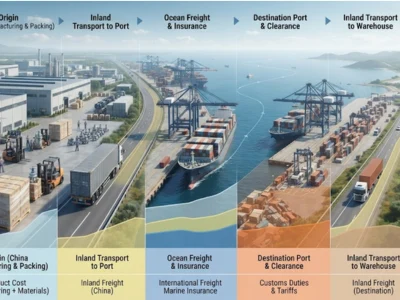
A supplier quotation shows what you pay for the goods under specific commercial terms. It doesn't necessarily show what the sourcing project will cost once freight, insurance, customs duties, tariffs, clearance charges, and inland transportation are included.
For industrial buyers importing components, machinery, industrial products, or custom-manufactured goods, these additional costs can materially change supplier economics.
Landed cost is the total cost incurred to purchase, transport, import, clear, and deliver goods to a defined destination.
That destination may be a port, warehouse, manufacturing facility, project site, or another agreed location. Defining it consistently allows procurement teams to calculate unit costs, compare suppliers, build realistic sourcing budgets, and identify the cost drivers that matter most.
Landed cost is therefore more than an accounting calculation. Used correctly, it becomes a procurement decision framework for comparing sourcing options on a consistent basis.
What Is Landed Cost?
Landed cost represents the total cost required to bring purchased goods from the supplier to a defined destination.
In international procurement, the calculation usually begins with the supplier price and adds buyer-paid transportation, insurance, import duties, tariffs, customs clearance, destination charges, and inland delivery costs required to reach that destination.
A basic landed cost formula is:
Landed Cost = Product Cost + Freight + Insurance + Duties and Tariffs + Customs and Regulatory Costs + Destination Costs
The exact calculation depends on the sourcing project.
An industrial product imported under EXW terms will have a different buyer-paid cost structure from the same product purchased FOB, CIF, DAP, or DDP. Product classification, country of origin, shipment volume, transportation mode, destination country, and customs requirements can also change the result.
Experienced procurement teams therefore use landed cost as a structured cost model rather than applying a fixed percentage to the supplier price.
Why Landed Cost Matters in Industrial Procurement
Supplier quotations are often based on different commercial terms, logistics arrangements, and delivery points.
Suppose Supplier A quotes an industrial component at $95 per unit while Supplier B quotes $100.
After buyer-paid logistics and import costs are added, the comparison may look different.
| Cost Component | Supplier A | Supplier B |
|---|---|---|
| Supplier Price | $95 | $100 |
| Freight | $14 | $8 |
| Duties and Tariffs | $8 | $5 |
| Customs and Handling | $4 | $3 |
| Inland Transportation | $5 | $3 |
| Unit Landed Cost | $126 | $119 |
Supplier B has the higher purchase price but the lower landed cost.
At industrial order volumes, relatively small differences in freight, tariff exposure, packaging efficiency, or inland transportation can materially affect annual procurement spending.
Landed cost analysis also helps buyers identify where costs are concentrated. A high product-cost share may justify supplier negotiation or value engineering, while high freight costs may indicate poor packaging efficiency, low container utilization, frequent partial shipments, or an unsuitable transportation mode.
For companies sourcing industrial products from China or other international manufacturing markets, this analysis helps determine whether offshore sourcing remains commercially attractive after the full acquisition cost is considered.

Before Calculating Landed Cost, Define the Cost Boundary
A landed cost calculation needs a clear destination point.
Common cost boundaries include:
Port of destination
Distribution center
Buyer's warehouse
Manufacturing facility
Construction or project site
Final customer location
The appropriate boundary depends on the purpose of the analysis.
If procurement teams are comparing suppliers, every sourcing option should be calculated to the same destination. If the objective is inventory valuation or plant-level cost analysis, the boundary may be the warehouse or manufacturing facility where the goods become available for use.
In practice, inconsistent commercial boundaries are a recurring source of procurement errors. One supplier may quote FOB, another EXW, and a third DAP, yet buyers sometimes compare the quoted unit prices before reconstructing each offer to the same destination.
The result may look precise in a spreadsheet while still producing the wrong supplier ranking.
What Costs Are Included in Landed Cost?
There is no single landed cost model that applies to every company and sourcing project.
The costs included should reflect the selected destination point, Incoterm, import requirements, and the company's documented costing policy.
Product and Supplier-Side Costs
Product cost is the amount paid to the supplier for the goods.
Depending on the Incoterm and commercial agreement, the quotation may also include export packaging, loading, origin transportation, export customs clearance, documentation, or other supplier-side services.
Procurement teams should verify exactly what the quoted price includes.
A quotation marked "$20 per unit" has limited decision value unless the buyer also knows the Incoterm and named place, order quantity, packaging assumptions, tooling arrangements, payment terms, and other commercial conditions that affect cost.
Freight and Transportation Costs
Freight costs cover transportation required to move the goods from the agreed delivery point to the selected destination.
These costs may include:
Factory pickup
Origin inland transportation
Origin handling
Ocean freight
Air freight
Rail freight
Truck transportation
Fuel surcharges
Freight forwarding charges
Shipment consolidation fees
Transportation costs depend on shipment weight, dimensions, volume, transportation mode, route, season, carrier capacity, and shipment frequency.
A recurring sourcing problem is using a freight rate from an earlier quotation while supplier prices and order volumes are updated. The resulting landed cost model combines current purchasing data with outdated logistics assumptions and can materially misstate the expected acquisition cost.
Freight assumptions should therefore be dated, documented, and updated before major sourcing decisions.

Cargo Insurance and Risk Coverage
Cargo insurance protects shipments against covered losses or damage during transportation.
Whether insurance should be added separately depends on the Incoterm and transportation agreement.
Under CIF, the seller arranges the insurance coverage required by that rule as part of its delivery obligation. Under FOB or EXW, the buyer may arrange insurance independently.
Procurement teams should verify the scope of coverage and whether the cost has already been included before adding insurance to the model.
Customs Duties, Tariffs, and Import Taxes
Import duties and tariffs can materially change the economics of international sourcing.
The amount payable may depend on:
HS or HTS classification
Customs value
Country of origin
Destination country
Trade agreements
Additional tariffs
Anti-dumping duties
Countervailing duties
Product-specific import requirements
Incorrect classification can distort landed cost estimates and create compliance exposure.
In practice, buyers sometimes receive suggested HS codes from suppliers based on previous exports. That information can be useful as a starting point, but the classification used in another country or transaction shouldn't automatically be treated as correct for the buyer's import declaration.
Where tariff exposure materially affects supplier selection, buyers should validate the classification, customs value, country of origin, and applicable trade measures before approving the sourcing decision.
Customs Clearance and Regulatory Costs
International shipments may generate costs beyond standard import duties.
These may include customs brokerage, documentation charges, customs examination fees, inspection costs, permits, regulatory testing, and other clearance-related expenses.
Some are predictable. Others arise only when a shipment is inspected, delayed, reclassified, or held for additional documentation.
Experienced buyers separate expected landed costs from contingent cost scenarios rather than hiding every possible expense inside one number. This makes the base calculation easier to compare while allowing procurement teams to evaluate customs and logistics risks separately.
Destination and Inland Transportation Costs
After goods arrive at the destination port or terminal, additional costs may be required before they reach the selected destination.
These may include:
Terminal handling
Port charges
Container drayage
Customs clearance
Temporary storage
Unloading
Inland trucking
Final delivery
Demurrage or detention when delays occur
Destination charges are a frequent source of budget variance because international freight quotations don't always cover every cost that occurs after arrival.
Procurement teams should confirm which charges are included, which are estimates, and which depend on events such as customs inspections, port congestion, free-time limits, or delayed container returns.
What Should Not Normally Be Included in Landed Cost?
Companies may build extended landed cost models for internal management purposes, but cost boundaries should remain clearly defined.
| Cost Item | Usually Included in Landed Cost? | Better Cost Classification |
| Supplier Price | Yes | Landed Cost |
| International Freight | Yes | Landed Cost |
| Cargo Insurance | Yes | Landed Cost |
| Import Duties and Tariffs | Yes | Landed Cost |
| Customs Brokerage | Yes | Landed Cost |
| Inland Delivery | Depends on Cost Boundary | Landed Cost |
| Supplier Audit Cost | Usually No | Procurement Cost |
| Supplier Management Cost | Usually No | Procurement Cost |
| Inventory Carrying Cost | Usually No | Supply Chain Cost or TCO |
| Quality Failure Cost | No | Cost of Poor Quality or TCO |
| Maintenance Cost | No | TCO |
| Downtime Cost | No | TCO |
| Disposal Cost | No | LCC |
Landed cost answers how much it costs to acquire and deliver goods to a defined destination.
TCO addresses broader ownership, operating, maintenance, quality, inventory, and other long-term economic consequences. LCC extends the analysis across the product or asset life cycle when that wider boundary is relevant.
Keeping these models separate makes supplier comparisons more consistent and allows procurement teams to add broader cost analysis when the purchasing decision requires it.
Landed Cost Formula
The basic formula is:
Total Landed Cost = Product Cost + Freight + Insurance + Duties and Tariffs + Customs and Regulatory Costs + Destination Costs
Unit landed cost is:
Unit Landed Cost = Total Landed Cost ÷ Number of Units
This formula works well when a shipment contains identical products.
Industrial shipments with multiple SKUs require more careful allocation because freight, insurance, customs duties, and handling costs may affect products differently.
For supplier comparison, a more practical concept is:
Normalized Landed Cost = Supplier Price Adjusted to a Common Cost Boundary + Buyer-Paid Logistics Costs + Import Costs + Destination Costs
Two calculations can both be mathematically correct and still be unsuitable for comparison if they use different Incoterms, destinations, tariff assumptions, or allocation methods.

How to Calculate Landed Cost Step by Step
Step 1 - Define the Destination Point
Determine where the calculation ends.
Use the same destination point for every supplier or sourcing option under comparison.
Step 2 - Confirm the Supplier Price and Incoterm
Record the Incoterm and named place, order quantity, packaging conditions, tooling arrangements, payment terms, and other commercial assumptions affecting cost.
Confirm which logistics and export-related costs are already included.
Step 3 - Identify the HS Code, Duty Rate, and Tariff Exposure
Confirm product classification and determine the applicable duty rate.
Review additional tariffs, anti-dumping duties, countervailing duties, trade agreements, and country-of-origin requirements where relevant.
For high-value industrial procurement projects, classification and tariff errors can outweigh small differences in supplier price.
Step 4 - Estimate Freight and Insurance
Collect transportation quotations based on realistic shipment data.
Relevant information may include:
Gross and net weight
Package dimensions
Shipment volume
Number of pallets or containers
Port of loading
Port of destination
Transportation mode
Delivery schedule
Record the quotation date, validity period, and major assumptions.
Step 5 - Add Customs and Destination Charges
Include predictable brokerage, clearance, port, terminal, handling, and inland transportation costs required to reach the destination.
Keep contingent risks separate when they can't be estimated reliably.
Step 6 - Allocate Shipment-Level Costs Across SKUs
Select allocation methods that reflect how each cost is generated.
Freight may follow weight, volume, or chargeable weight. Insurance may follow product value, while duties should follow customs value and the applicable tariff classification.
Step 7 - Calculate Total and Unit Landed Cost
Add all included costs to determine total landed cost.
Allocate the result to products, SKUs, or units using the selected method and compare sourcing alternatives on the same basis.
Illustrative Landed Cost Example for Industrial Products Sourced from China
The following simplified example demonstrates the calculation method. It isn't a Sijitonghui client case, and the figures shouldn't be interpreted as current freight rates, tariff rates, customs guidance, or a quotation for industrial valves.
Actual import costs depend on product specifications, classification, country of origin, destination, shipment conditions, Incoterms, and current trade regulations.
Consider a U.S. industrial buyer sourcing 5,000 industrial valves from a Chinese manufacturer under FOB terms.
The supplier price is $18 per valve, and the buyer wants to calculate landed cost to its warehouse.
| Cost Component | Calculation Basis | Illustrative Cost |
| Product Cost | 5,000 × $18 | $90,000 |
| Ocean Freight | Shipment Estimate | $6,800 |
| Cargo Insurance | Shipment Estimate | $450 |
| Import Duty | Simplified Assumption | $4,500 |
| Additional Tariff | Simplified Assumption | $6,750 |
| Customs Brokerage | Entry and Clearance | $650 |
| Port and Terminal Charges | Destination Estimate | $1,200 |
| Inland Transportation | Port to Warehouse | $2,400 |
| Total Landed Cost | Sum of Included Costs | $112,750 |
The illustrative unit landed cost is:
$112,750 ÷ 5,000 = $22.55 per valve
The example shows how logistics and import costs can materially change the acquisition cost used for supplier comparison and budgeting.
It also demonstrates why procurement teams should compare complete sourcing options.
A manufacturer quoting $19 per valve could still produce a lower landed cost if its location, packaging, container utilization, tariff exposure, commercial terms, or logistics arrangements create sufficient savings elsewhere in the cost structure.

How Incoterms Affect Landed Cost
Incoterms define the allocation of specified delivery obligations, costs, and risks between buyers and sellers.
For landed cost analysis, their practical importance is that they help procurement teams identify which costs are included in the supplier quotation and which remain the buyer's responsibility.
| Incoterm | Supplier Quote Generally Covers | Buyer Must Evaluate and Add |
| EXW | Goods Made Available at Seller's Premises | Pickup, Origin Charges, Export Formalities Where Applicable, Freight, Insurance, Import Costs, Destination Delivery |
| FOB | Goods Delivered on Board at Named Port | Main Freight, Insurance, Import Costs, Destination Charges, Inland Delivery |
| CIF | Goods, Freight, and Required Insurance to Named Destination Port | Import Duties, Clearance, Destination Charges, Inland Delivery |
| DAP | Delivery to Named Place | Import Clearance, Duties, Taxes, and Applicable Import Costs |
| DDP | Delivery With Most Transportation and Import Responsibilities Assigned to Seller | Verify Import Compliance, Tax Treatment, Exclusions, and Cost Transparency |
No Incoterm is universally the lowest-cost option.
The more useful question is which arrangement provides an appropriate balance of cost visibility, logistics control, internal capability, and execution risk.
Incoterm Decision Guidance for Industrial Buyers
| Buyer Situation | Practical Starting Point | Procurement Consideration |
| Buyer has established freight forwarders and strong import capabilities | FOB | Provides control over main freight without requiring the buyer to manage every origin activity |
| Buyer wants maximum logistics control and can manage origin operations | EXW or FCA | Requires careful management of pickup, export formalities, origin charges, and operational responsibilities |
| Buyer prefers the seller to arrange main ocean freight | CIF | Freight convenience doesn't eliminate the need to analyze destination charges and import costs |
| Buyer wants delivery to a named facility but can manage import clearance | DAP | Can simplify transportation coordination while preserving buyer control over import procedures |
| Buyer prioritizes simpler delivered pricing and has limited import capabilities | DDP | Requires careful verification of importer responsibilities, compliance arrangements, tax treatment, and cost transparency |
In sourcing projects, the lowest quoted EXW price can become less attractive after origin charges and buyer coordination costs are added. Conversely, a DDP quotation may simplify budgeting but reduce visibility into freight, duty, tax, and service margins.
The Incoterm should support the buyer's procurement strategy rather than serve as a shortcut for selecting the lowest quoted price.
How to Compare Suppliers Using Landed Cost
Calculating landed cost produces a number. Procurement analysis begins when buyers compare and interpret that number.
A practical approach uses three perspectives.
Horizontal Comparison
Horizontal comparison evaluates competing suppliers for the same sourcing requirement.
| Cost Component | Supplier A | Supplier B | Supplier C |
| Supplier Price | $95 | $100 | $102 |
| Freight | $14 | $8 | $7 |
| Duties and Tariffs | $8 | $5 | $4 |
| Customs and Destination Costs | $9 | $6 | $5 |
| Unit Landed Cost | $126 | $119 | $118 |
All suppliers should be compared using consistent commercial assumptions.
Vertical Comparison
Vertical comparison tracks landed cost over time.
Buyers can compare current costs with previous orders, quarterly averages, annual averages, or procurement budgets.
This analysis helps distinguish supplier price changes from freight, exchange rate, tariff, volume, and logistics effects.
Structural Comparison
Structural comparison evaluates each component as a share of total landed cost.
| Cost Component | Share of Total Landed Cost |
| Product Cost | 70% |
| Freight and Insurance | 12% |
| Duties and Tariffs | 10% |
| Customs and Destination Costs | 8% |
The cost structure indicates where procurement teams should investigate savings opportunities.
A recurring sourcing mistake is negotiating every supplier for a lower unit price before identifying the largest cost driver. A 2 percent price reduction may create less value than improving container utilization, correcting inefficient packaging, consolidating shipments, or reducing avoidable destination charges.
Supplier Comparison Decision Guidance
| Analysis Result | Procurement Response |
| Supplier price is high but landed cost is competitive | Investigate logistics efficiency, tariff position, and operational advantages before rejecting the supplier |
| Supplier price is low but freight share is unusually high | Review packaging, factory location, shipment planning, and Incoterm structure |
| Landed costs are similar across suppliers | Shift greater attention to quality, capacity, delivery performance, supplier reliability, and supply risk |
| One supplier is highly sensitive to tariff or freight changes | Run scenario analysis and consider diversification or commercial risk mitigation |
| Historical landed cost is rising while supplier price is stable | Investigate logistics, exchange rates, tariffs, shipment volume, and destination charges before starting price negotiations |
The objective is to identify why costs differ and whether those differences are sustainable.

Common Landed Cost Calculation Mistakes
Comparing Quotations With Different Commercial Boundaries
EXW, FOB, CIF, DAP, and DDP quotations contain different cost responsibilities.
Reconstruct each sourcing option to the selected destination before comparing results.
Using the Wrong HS or HTS Code
Incorrect classification can create inaccurate duty estimates and customs compliance problems.
Validate classification when tariff exposure could materially affect the sourcing decision.
Ignoring Additional Tariffs and Trade Remedies
Standard duty rates may not represent the complete import cost.
Additional tariffs, anti-dumping duties, countervailing duties, and other trade measures should be reviewed where applicable.
Allocating Freight Equally Across Dissimilar Products
A mixed industrial shipment may contain small precision components and bulky valve bodies.
Allocating ocean freight equally per unit can assign similar freight costs to products that consume very different amounts of container space, distorting SKU margins and supplier comparisons.
Using Outdated Freight or Exchange Rate Assumptions
International transportation costs and currency values change.
Update material assumptions before issuing purchase orders or making major supplier decisions.
Mixing Landed Cost With TCO
Supplier audits, quality failures, maintenance, downtime, and inventory carrying costs may be commercially important without belonging in the narrow landed cost model.
Evaluate these factors separately when the sourcing decision requires a broader economic analysis.
How to Allocate Freight and Import Costs Across Multiple SKUs
Industrial shipments often contain products with different weights, volumes, values, and tariff classifications.
Dividing shared shipment costs equally across units can materially distort product economics.
| Allocation Method | Best Used When | Main Limitation |
| Quantity | Products Are Similar in Size and Value | Distorts Costs for Dissimilar Products |
| Weight | Freight Is Driven Mainly by Physical Weight | Ignores Space Consumption |
| Volume | Ocean Freight or Container Space Drives Cost | May Underallocate Dense Products |
| Product Value | Insurance or Value-Based Costs | Doesn't Reflect Physical Logistics Costs |
| Hybrid Allocation | Multiple Cost Drivers Affect the Shipment | Requires Better Data and More Administration |
The allocation method should follow the underlying cost driver whenever practical.
Ocean freight can often be allocated by CBM or container space consumption. Air freight is commonly influenced by chargeable weight, while insurance can be allocated according to insured product value.
Duties should follow customs value and tariff classification rather than a generic shipment-level percentage.
In practice, mixed shipments create problems when procurement, logistics, and finance teams use different allocation rules. Establishing a documented method improves consistency across supplier comparison, inventory costing, pricing, and cost reduction analysis.
Why Landed Cost Should Be Modeled as a Range
Landed cost calculations rely on assumptions that may change before goods arrive.
Freight rates move. Exchange rates fluctuate. Tariff exposure can change. Shipment volumes and container utilization may differ from the original plan.
Procurement teams can improve decision quality by modeling scenarios.
| Variable | Base Case | Expected Case | Stress Case |
| Ocean Freight | $6,000 | $7,000 | $9,000 |
| Exchange Rate Movement | 0% | 3% | 7% |
| Additional Tariff | 0% | 5% | 15% |
| Container Utilization | 90% | 80% | 65% |
The objective isn't to predict every future cost.
It is to identify which variables could change the supplier decision.
If Supplier A remains competitive across reasonable scenarios, the sourcing decision may be relatively robust. If a small freight or tariff change reverses the supplier ranking, procurement teams should recognize the exposure before committing volume or becoming dependent on one source.
How to Reduce Landed Cost Without Increasing Supply Risk
Effective cost reduction begins with identifying the cost components that create the largest economic burden.
When Product Cost Is High
Procurement teams can use competitive sourcing, cost breakdown analysis, should-cost modeling, specification review, process improvement, and value engineering.
Price pressure should remain commercially sustainable. Forcing suppliers below viable cost levels can create quality deterioration, material substitution, reduced service, or supply instability.
When Freight Cost Is High
Review packaging dimensions, pallet configuration, container utilization, shipment consolidation, transportation mode, order schedules, routes, and Incoterms.
Improving packaging or shipment planning may create more savings than negotiating another small reduction in unit price.
When Duties and Tariffs Are High
Review product classification, country of origin, trade agreement eligibility, supplier manufacturing locations, and sourcing geography.
Any tariff optimization strategy should remain compliant with customs and trade regulations.
When Destination Costs Are High
Investigate customs delays, documentation quality, broker coordination, port selection, free-time management, inland transportation, and recurring demurrage, detention, or storage charges.
When Landed Costs Are Similar
Don't force a supplier decision based on small cost differences.
Shift the evaluation toward manufacturing capability, quality consistency, delivery performance, production capacity, communication, financial stability, and supply continuity.
This is where landed cost analysis should connect with broader supplier qualification and sourcing risk management.
Landed Cost vs Purchase Price vs TCO vs LCC
Different cost models answer different procurement questions.
| Cost Model | Main Question | Typical Cost Boundary | Best Procurement Use |
| Purchase Price | What does the supplier charge? | Supplier Invoice | Initial Quotation Comparison |
| Landed Cost | What does it cost to bring the goods to a defined destination? | Acquisition Through Delivery | Supplier and Sourcing Comparison |
| TCO | What does it cost to acquire, own, operate, and manage the product? | Ownership Period | Long-Term Procurement Decision |
| LCC | What does the product or asset cost across its full life cycle? | Acquisition or Design Through Disposal | Capital Equipment and Long-Term Asset Evaluation |
These models represent progressively broader cost boundaries.
For imported industrial goods, landed cost is often the appropriate starting point for supplier comparison. When quality failures, inventory exposure, maintenance, downtime, or operating costs could change the commercial outcome, procurement teams should extend the analysis to TCO or LCC.
A Practical Landed Cost Checklist for Industrial Buyers
Before approving a sourcing decision, procurement teams should verify:
Is the destination point clearly defined?
Are all suppliers compared to the same commercial boundary?
Are Incoterms and named places documented?
Is the scope of each supplier quotation clear?
Have HS or HTS classifications been reviewed where tariffs are material?
Are applicable duties, tariffs, and import taxes included?
Are freight assumptions based on realistic shipment data?
Are quotation dates and validity periods recorded?
Have customs brokerage and destination charges been considered?
Is the allocation method appropriate for multi-SKU shipments?
Are exchange rate assumptions documented?
Have total and unit landed costs been calculated?
Have suppliers been compared horizontally?
Have current costs been compared with historical costs?
Has the landed cost structure been analyzed?
Have material cost variables been stress-tested?
Have supplier quality, capacity, delivery performance, and supply risks been evaluated separately?
A repeatable landed cost process gives procurement teams better information before purchase orders are placed and creates a stronger basis for future cost analysis.
The Sijitonghui Landed Cost Analysis Framework
Sijitonghui approaches sourcing cost analysis as part of a broader industrial procurement process.
The framework connects seven decision layers.
1. Cost Boundary
Define where the cost calculation ends and ensure every sourcing option uses the same commercial boundary.
2. Cost Identification
Identify supplier-side, logistics, insurance, import, customs, and destination costs relevant to the sourcing project.
3. Cost Normalization
Reconstruct quotations with different Incoterms, named places, and logistics responsibilities so buyers can compare sourcing options consistently.
4. Cost Allocation
Allocate shipment-level freight, insurance, customs, and handling costs using methods that reflect the underlying cost drivers.
5. Cost Comparison
Use horizontal comparison across suppliers, vertical comparison over time, and structural comparison across cost categories.
6. Cost Sensitivity
Evaluate whether freight, exchange rates, tariffs, shipment volume, or container utilization could materially change the sourcing decision.
7. Procurement Decision
Combine landed cost findings with supplier qualification, manufacturing capability, quality assurance, delivery performance, and supply chain risk.
This framework reflects how Sijitonghui supports industrial buyers sourcing products, components, and manufacturing solutions from China.
Our work may include identifying and evaluating manufacturers, verifying suppliers, conducting factory audits, coordinating quality assurance and inspections, clarifying commercial terms, collecting logistics information, comparing sourcing options, and supporting supply chain execution.
The objective isn't to provide buyers with another supplier price.
It is to help procurement teams understand the manufacturing, cost, quality, logistics, and risk assumptions behind sourcing decisions before they commit orders and build long-term supplier relationships.
If you're evaluating industrial suppliers or reviewing the true cost of sourcing products from China, speak with a sourcing expert to discuss your sourcing requirements and procurement strategy.
Frequently Asked Questions About Landed Cost
What is landed cost in procurement?
Landed cost is the total cost required to purchase, transport, import, clear, and deliver goods to a defined destination. It commonly includes the supplier price, freight, insurance, customs duties, tariffs, customs clearance, destination charges, and inland transportation costs paid by the buyer.
What is the difference between purchase price and landed cost?
Purchase price is the amount paid to the supplier under the agreed commercial terms. Landed cost adds the buyer-paid logistics, import, customs, and destination costs required to bring the goods to the selected location.
What is the formula for landed cost?
A practical formula is Product Cost + Freight + Insurance + Duties and Tariffs + Customs and Regulatory Costs + Destination Costs. The exact components depend on the Incoterm, destination point, import regulations, and company costing policy.
Does landed cost include customs duties and tariffs?
Yes. Import duties, tariffs, and other applicable import charges are normally included when the buyer is responsible for paying them before the goods reach the defined destination.
Does landed cost include warehouse costs?
Costs required to deliver goods to the selected warehouse may be included when the warehouse is the defined destination. Ongoing warehousing and inventory carrying costs are generally treated as supply chain costs or part of TCO rather than narrow landed cost.
How do Incoterms affect landed cost?
Incoterms help define specified delivery obligations, costs, and risks between buyers and sellers. Procurement teams should identify which costs are included in each quotation and reconstruct sourcing options to the same destination before comparing landed costs.
Is the supplier with the lowest landed cost always the best choice?
No. Similar landed costs can produce different procurement outcomes because of supplier quality, manufacturing capability, delivery performance, lead time, financial stability, and supply continuity. Landed cost should be combined with supplier evaluation and broader cost analysis when these factors are material.
How often should companies update landed cost calculations?
Update calculations whenever material inputs change, including supplier prices, freight rates, exchange rates, tariffs, shipment volumes, Incoterms, sourcing locations, or destination costs. Companies managing frequent international shipments should maintain landed cost models as part of their ongoing procurement process.
Final Thoughts
Landed cost gives industrial buyers a more useful view of sourcing economics than supplier price alone.
A reliable analysis defines the destination, identifies the relevant costs, reconstructs quotations to a consistent commercial boundary, allocates shared shipment expenses appropriately, and compares sourcing options using current and documented assumptions.
The strongest procurement teams go further.
They compare costs across suppliers, track changes over time, analyze the structure of landed cost, and test whether freight, tariffs, exchange rates, or shipment conditions could change the decision.
When broader factors such as supplier quality, delivery reliability, inventory exposure, maintenance, or downtime become material, buyers should extend the analysis beyond landed cost to supplier risk evaluation, TCO, or LCC.
The goal isn't to find the lowest number in a quotation spreadsheet.
It is to select sourcing options with better cost visibility, reliable execution, manageable risk, and stronger long-term supply chain performance.