

Many machining teams spend months testing different insert grades while the dominant boring problem never changes.
The insert changes.
The vibration does not.
In long overhang boring, manufacturers often upgrade from carbide to ceramic or PCBN expecting better wear resistance and improved bore accuracy. Sometimes the result is the opposite. Wear resistance improves on paper, but chatter becomes less predictable, insert fracture begins appearing near bore entry points, and offset correction frequency increases during production.
A more expensive insert cannot stabilize a boring bar that is already vibrating excessively.
This is one reason why insert material selection in precision boring should never be treated as a simple hardness comparison.
Actual machining performance depends on the complete machining system:
- Machine rigidity
- Damping stability
- Overhang length
- Insert seat rigidity
- Chip evacuation
- Coolant penetration
- Toolpath behavior
- Thermal buildup inside the bore
- Operator consistency
- Automation stability
In many precision boring applications, damping performance limits productivity long before insert material capability does.
Why the Cheapest Insert Often Creates the Highest Cost Per Bore
Insert purchase price is usually one of the smallest costs in a precision boring process.
The larger costs normally come from instability:
- Scrap caused by bore taper
- Chatter marks inside finished bores
- Tool offset drift
- Unexpected insert fracture
- Surface finish inconsistency
- Interrupted automation cycles
- Manual inspection
- Operator intervention
- Reduced spindle uptime
Many precision boring applications intentionally run below theoretical cutting parameters because stable production creates better long-term throughput than aggressive but inconsistent machining.
That decision may appear inefficient in isolation.
In real production environments, it often reduces overall manufacturing cost.
This becomes especially important in:
- Hydraulic valve body boring
- Automotive transmission bores
- Mold component finishing
- Deep-hole precision machining
- Multi-shift unattended production
Why Precision Boring Changes Insert Behavior Completely
Many insert recommendations are developed around stable external turning conditions.
Precision boring behaves differently.
As bore depth increases:
- Heat becomes trapped inside the bore
- Chips become harder to evacuate
- Tool deflection increases
- Vibration amplifies through the boring bar
- Edge loading becomes unstable near bore transitions
A ceramic insert that performs perfectly during rigid external roughing may fail within minutes inside a long unsupported bore.
Some production environments machine cast iron successfully with ceramics for extended periods, then suddenly experience edge failure after extending overhang for a larger housing bore. The insert grade remains unchanged. The cutting parameters remain nearly identical. But chatter near the bore entrance begins damaging edge stability almost immediately.
The insert did not suddenly become worse.
The boring dynamics changed.
Why Damping Stability Often Matters More Than Insert Grade
Many long overhang boring problems classified as insert wear issues are actually vibration problems.
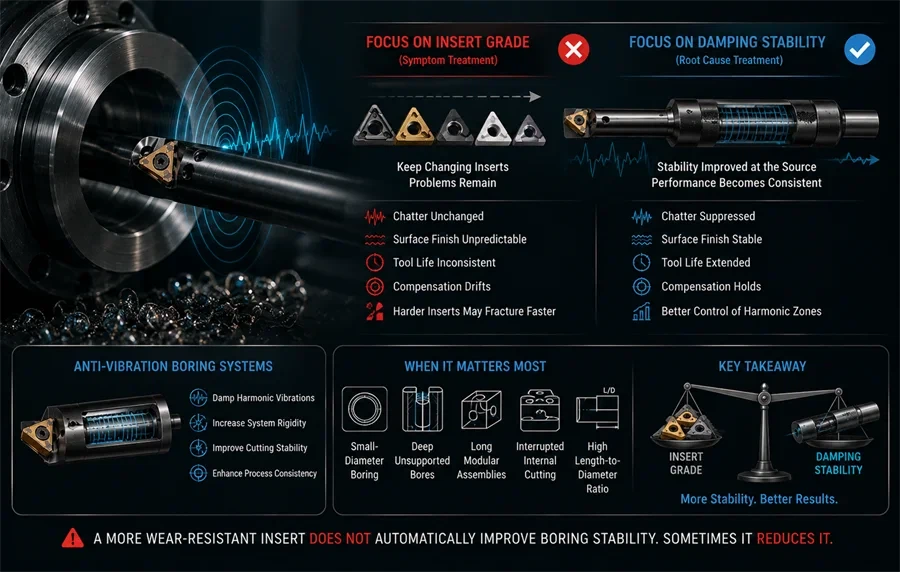
This becomes obvious when production teams continue upgrading insert materials while chatter patterns remain unchanged.
In unstable boring environments:
- Harder inserts may fracture faster
- Surface finish becomes less predictable
- Tool compensation drifts more aggressively
- Harmonic vibration zones become harder to control
Some machining operations continue changing insert grades every few weeks while the boring bar itself continues vibrating the same way it did from the beginning.
In these situations, anti-vibration boring systems usually create more improvement than insert upgrades alone.
This is especially true in:
- Small-diameter boring
- Deep unsupported bores
- Long modular assemblies
- Interrupted internal cutting
- High length-to-diameter ratio applications
A more wear-resistant insert does not automatically improve boring stability.
Sometimes it reduces it.
Why Machine Architecture Changes Insert Performance
Machine-tool behavior strongly affects insert reliability.
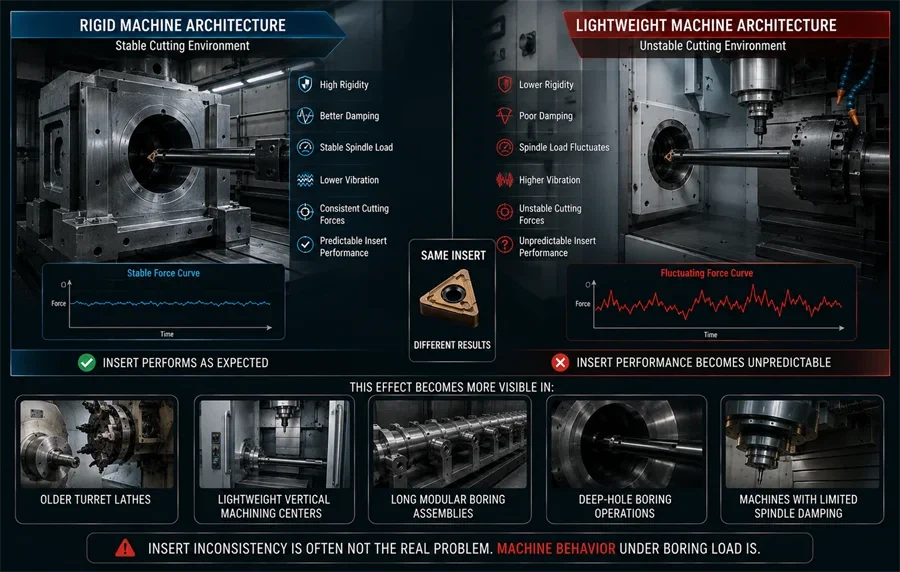
Rigid box-way machines often tolerate vibration differently from lightweight high-speed machines. Horizontal boring mills may maintain stable cutting forces during long internal cuts while lighter vertical machining centers amplify harmonic chatter once overhang increases.
The same insert can behave completely differently between machines.
PCBN inserts that perform predictably on rigid boring mills sometimes become unstable on lighter turret-based systems where spindle load fluctuates during interrupted cuts.
Many production environments incorrectly interpret this as insert inconsistency when the real issue is machine behavior under boring load.
This becomes increasingly visible in:
- Older turret lathes
- Lightweight vertical machining centers
- Long modular boring assemblies
- Deep-hole boring operations
- Machines with limited spindle damping
Why Stable Tool Wear Is More Valuable Than Maximum Tool Life in Automation
In automated machining, predictable wear matters more than theoretical maximum tool life.
A slightly shorter but highly stable wear pattern allows:
- Reliable tool compensation
- Stable automation timing
- Lower inspection frequency
- Consistent bore finish
- Reduced line interruption risk
By comparison, inserts that fail unpredictably create major production instability even if theoretical wear resistance appears excellent in testing data.
This is one reason why many automated boring applications still rely heavily on tougher carbide grades.
Gradual flank wear is easier to manage than sudden fracture.
Some production teams discover that harder insert materials actually increase downtime because vibration makes wear behavior less predictable under real machining conditions.
Carbide Inserts - Why They Still Dominate Many Real Boring Environments
Carbide inserts remain widely used because they balance:
- Toughness
- Wear resistance
- Cost control
- Vibration tolerance
- Process flexibility
In unstable machining environments, carbide often produces better overall productivity than harder but more brittle materials.
Why Carbide Often Performs Better Than Expected in Long Overhang Boring
Carbide inserts usually fail gradually through:
- Flank wear
- Edge rounding
- Progressive micro-chipping
This gradual degradation helps operators maintain bore consistency through predictable offset adjustment.
Some production environments unknowingly reduce bore accuracy after upgrading to harder insert materials because edge behavior becomes less forgiving once vibration increases.
A tougher carbide insert running conservatively may outperform ceramic or PCBN inserts simply because the wear pattern remains stable enough for consistent production.
This becomes especially important in mixed-production environments where setups change frequently.
Where Carbide Usually Creates the Best ROI
Carbide often remains the most practical option for:
- Interrupted boring
- Semi-finishing
- Mixed operator environments
- Machines with inconsistent rigidity
- Long overhang applications
- General-purpose precision boring
In many production environments, carbide delivers the best total cost per bore rather than the highest cutting speed.
Cermet Inserts - Strong Finishing Performance With Narrow Stability Windows
Cermet inserts are commonly selected for fine finishing operations where bore finish quality and dimensional repeatability are priorities.
Compared with carbide, cermet often produces:
- Cleaner surface finish
- Lower built-up edge tendency
- Better dimensional consistency
- More stable finishing performance in steel machining
Where Cermet Performs Well
Cermet performs especially well in:
- Stable CNC finishing
- Fine boring
- Continuous cutting
- Precision steel finishing
- Rigid modular boring systems
When vibration is already controlled, cermet can improve bore quality significantly.
Why Cermet Can Become Unstable Quickly
Cermet has lower toughness than carbide.
As boring instability increases, cermet may begin showing:
- Edge chipping near bore entry
- Sudden finish deterioration
- Tool compensation instability
- Dimensional drift
Some production teams attempt to solve this by upgrading insert grades repeatedly while ignoring the fact that boring bar vibration is amplifying edge loading during every cycle.
The insert keeps changing.
The instability remains.
Ceramic Inserts - Extremely Productive but Highly Sensitive to Real Boring Conditions
Ceramic inserts excel in high-temperature cutting environments.
Under stable conditions, they can dramatically improve material removal rates.
Where Ceramic Inserts Deliver Strong Productivity
Ceramics are highly effective for:
- Cast iron roughing
- High-speed continuous cutting
- Heat-resistant alloy machining
- Stable horizontal boring mills
- Large-scale rough boring
In rigid roughing environments, ceramic productivity can be extremely high.
Why Ceramic Inserts Often Fail in Deep-Hole Boring
Deep-hole boring creates multiple instability problems simultaneously:
- Vibration concentration
- Interrupted bore transitions
- Chip packing
- Thermal fluctuation
- Inconsistent coolant penetration
Many deep-hole boring failures classified as insert wear problems are actually chip evacuation failures.
As chips begin packing inside the bore:
- Chips start welding against hot bore surfaces
- Recutting damages the insert edge
- Coolant carries loose chips back toward the cutting zone
- Heat concentration rises rapidly
- Bore finish deteriorates unexpectedly
Some bores remain stable for the first 20 parts, then suddenly develop finish instability once heat accumulation changes chip behavior inside the bore.
This is one reason why ceramic performance may collapse suddenly even when insert wear initially appears stable.
PCBN Inserts - Excellent Hardened Bore Performance With High Rigidity Demands
PCBN inserts are widely used for hardened steel finishing where dimensional consistency and grinding replacement are priorities.
Although insert cost is high, PCBN often lowers overall operational cost through:
- Stable bore geometry
- Reduced secondary grinding
- Long finishing consistency
- Improved automation reliability
- Lower inspection frequency
This makes PCBN highly effective for:
- Bearing bores
- Hardened hydraulic components
- Mold tooling
- Automotive transmission bores
Why PCBN Often Disappoints in Unstable Boring Environments
PCBN performs best when vibration remains tightly controlled.
In unstable setups, PCBN inserts may fracture suddenly rather than wear gradually.
As overhang increases, the risk rises rapidly.
This becomes even worse when:
- Insert seat rigidity weakens
- Modular boring joints introduce micro-movement
- Harmonic vibration zones develop
- Coolant flow becomes unstable
- Cross-hole interruptions shock the cutting edge
Many production environments spend months testing PCBN grades while the dominant problem remains unchanged - insufficient damping stability inside the boring system.
PCD Inserts - Extremely Effective for Stable Non-Ferrous Machining
PCD inserts are commonly used for:
- Aluminum boring
- Copper alloy machining
- Composite materials
- High-speed non-ferrous finishing
PCD offers:
- Extremely long tool life
- Excellent thermal conductivity
- Strong wear resistance
- High-quality surface finish
In stable automated aluminum production, PCD often lowers long-term tooling cost significantly.
Why PCD Performance Can Collapse Under Poor Chip Control
In deep bores, chip evacuation becomes critical.
When coolant pressure and chip evacuation become unstable:
- Packed chips scratch finished bore surfaces
- Recutting damages the insert edge
- Heat accumulates inside blind bores
- Bore finish consistency collapses
Some production environments respond by increasing insert hardness when the actual limitation is insufficient chip evacuation capacity.
Why Insert Seat Stability and Modular Rigidity Matter
Insert material performance depends heavily on insert seating stability.
Even premium insert materials perform poorly when:
- Insert seat rigidity weakens
- Clamping repeatability changes between indexes
- Modular joints amplify vibration
- Long assemblies introduce micro-movement
In long overhang boring, even small movement at the insert seat may increase:
- Bore taper
- Chatter
- Surface finish inconsistency
- Harmonic vibration
- Edge chipping
This is one reason why anti-vibration boring systems often improve insert ROI more effectively than insert material upgrades alone.
Why the Most Wear-Resistant Insert Is Not Always the Most Productive
Higher wear resistance does not automatically improve machining productivity.
In unstable boring environments, harder insert materials may become less predictable once vibration increases.
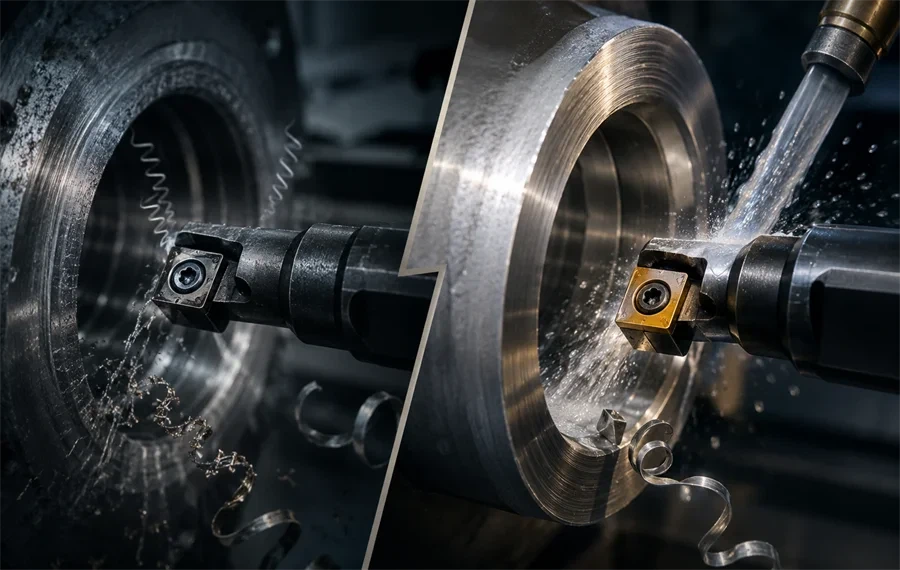
Many production environments improve bore stability more effectively by:
- Shortening overhang
- Increasing damping performance
- Adding semi-finish stabilization passes
- Reducing entry shock near bore transitions
- Increasing coolant pressure carefully
- Adjusting insert nose radius
rather than upgrading insert hardness.
Higher coolant pressure may improve chip evacuation while simultaneously increasing thermal shock risk for ceramics.
Reducing cutting speed may decrease theoretical productivity while improving long-term spindle uptime overall.
These are real production compromises.
The best theoretical setup is not always the most stable production setup.
Common Insert Material Selection Mistakes
Several problems repeatedly appear in real production environments.
Selecting Inserts Only From Catalog Data
Catalog recommendations usually assume ideal rigidity and stable cutting conditions.
Real boring environments rarely match those assumptions.
Ignoring Vibration as the Dominant Variable
Many machining operations continue changing insert grades while vibration amplitude remains completely uncontrolled.
Treating Chip Evacuation as a Secondary Problem
Many deep-hole boring failures originate from chip packing and heat concentration rather than insufficient insert hardness.
Upgrading Inserts Without Improving Damping Stability
Premium inserts cannot stabilize an unstable boring system.
Ignoring Operator Dependency
Some insert materials are far less forgiving under setup variation.
In mixed operator environments, slightly tougher inserts often create more stable long-term production.
A Practical Way to Evaluate Insert Material Selection
The best insert material depends on the complete machining environment.
A practical evaluation process should consider:
| Machining Factor | Real Production Question |
|---|---|
| Machine Rigidity | Will machine structure remain stable under boring load? |
| Overhang Length | Will vibration dominate before insert wear becomes critical? |
| Damping Stability | Is chatter already limiting bore quality? |
| Chip Evacuation | Can chips exit the bore consistently during long cycles? |
| Coolant Delivery | Is coolant reaching the cutting zone reliably? |
| Automation Level | Is predictable wear more important than peak cutting speed? |
| Operator Variation | Does the setup require forgiving insert behavior? |
| Bore Finish Requirement | Is dimensional consistency more important than aggressive removal rate? |
In many precision boring environments, the best solution is not the hardest insert material.
The best solution is the insert material that remains most stable inside the actual boring system.
Final Thoughts
Insert material selection is fundamentally a boring stability decision rather than a simple hardness comparison.
Successful precision boring depends on balancing:
- Insert material behavior
- Machine rigidity
- Damping performance
- Chip evacuation
- Thermal stability
- Toolpath consistency
- Automation reliability
- Bore accuracy requirements
Manufacturers that evaluate inserts through total machining stability rather than insert purchase price alone usually achieve better bore consistency, lower downtime, and more reliable long-term production.
In many unstable boring operations, production teams spend months testing insert grades while the dominant problem remains unchanged - insufficient rigidity, poor damping behavior, unstable chip evacuation, or uncontrolled vibration inside the bore.


