

Many manufacturing teams still evaluate insert life using one basic assumption - longer insert life means lower machining cost.
In precision boring, that assumption often creates unstable production instead of savings.
A boring insert may continue cutting long after the machining process itself has already started deteriorating. Bore repeatability drifts gradually, spindle load begins fluctuating, surface finish changes slightly, and chatter marks start appearing intermittently inside the bore.
The insert still cuts.
The process window is already narrowing.
This becomes especially common in:
- long-overhang boring
- deep-hole machining
- small-diameter boring
- hydraulic component machining
- unattended CNC production
- tight-tolerance finish boring
In these applications, the real objective is rarely maximum insert lifespan.
The real objective is stable boring behavior over long production runs.
That includes:
- repeatable bore size
- stable surface finish
- predictable wear progression
- reliable chip evacuation
- controlled thermal behavior
- consistent cutting force
- unattended machining reliability
A stable 25-minute insert life is often more valuable than an unpredictable 50-minute insert life.
Boring Wear Behaves Differently From External Turning
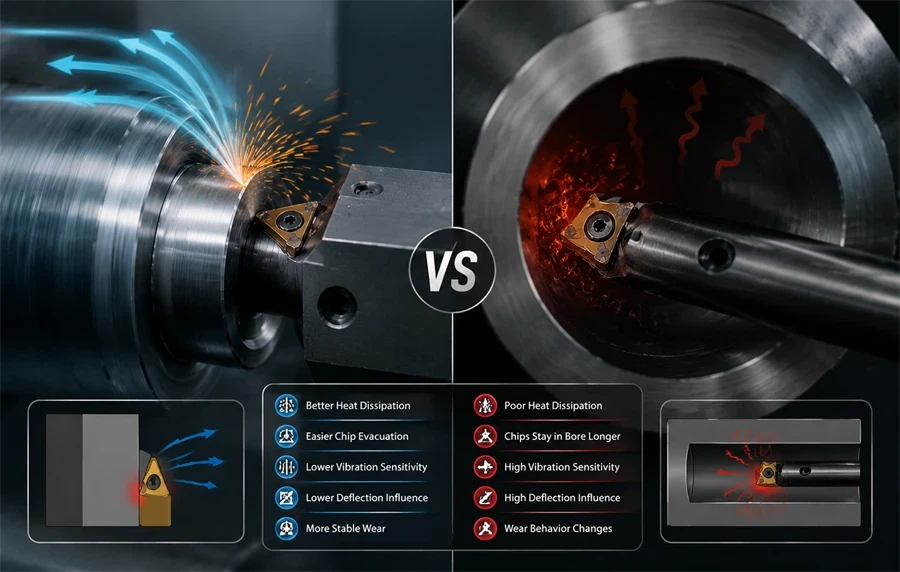
External turning dissipates heat relatively easily.
Boring does not.
Inside a bore, the cutting edge operates in a partially enclosed cutting environment where heat, vibration, chip flow, and radial deflection continuously influence each other.
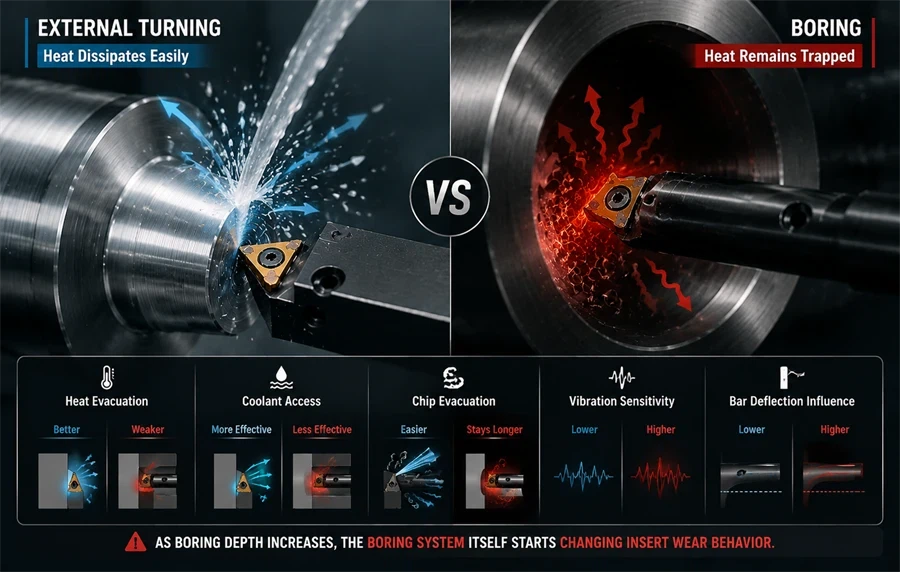
As boring depth increases:
- heat evacuation weakens
- coolant access becomes less effective
- chips remain inside the bore longer
- vibration sensitivity increases rapidly
- boring bar deflection becomes more influential
The boring system itself starts changing insert wear behavior.
This is one reason many production environments continue changing insert grades repeatedly without solving unstable tool life problems.
The insert is often not the real limitation.
The boring system is.
In stable boring conditions, wear usually progresses gradually and predictably.
Once the boring system loses stability, insert wear often accelerates very quickly.
Operators sometimes notice the spindle sound becoming slightly sharper several parts before chatter marks appear visibly inside the bore.
That usually means the wear pattern is already destabilizing.
Why Cutting Speed Influences Tool Life So Aggressively
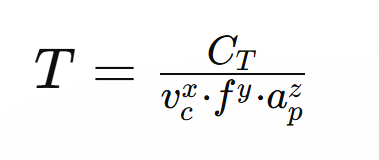
Tool life is commonly expressed using the following relationship:
For YT5 carbide tools machining carbon steel, the relationship is often written as:
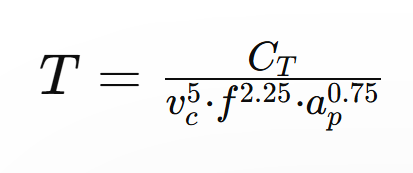
The equation shows that cutting speed has the strongest influence on insert life.
The practical implication matters more than the formula itself.
In unstable boring operations, relatively small spindle speed increases may create disproportionately large wear increases.
This usually happens when cutting temperature and vibration fluctuation begin interacting inside the bore simultaneously.
Once thermal instability begins affecting cutting force consistency, insert wear may stop progressing linearly.
Many machining teams reduce feed rate first when insert life becomes unstable.
In boring applications, cutting speed is usually the more sensitive variable.
Higher cutting speed rapidly increases:
- edge temperature
- thermal fatigue
- coating breakdown
- crater wear
- edge softening
- vibration sensitivity
However, reducing spindle speed does not always stabilize wear.
Some manufacturing environments continue slowing the spindle down while the boring bar keeps vibrating throughout the cut.
Insert life changes very little.
Deep-hole boring sometimes behaves this way because the insert remains inside the bore longer during each pass. Chips stay hot longer, chip smearing increases, and heat exposure time rises even though spindle speed decreases.
This is one reason deep-hole boring wear behavior often feels inconsistent compared with external turning.
Why Maximum Insert Life Often Destabilizes Production
One of the most common production mistakes is pushing inserts until visible failure.
On paper, this improves insert utilization.
In real machining environments, it often destabilizes the process first.
In precision boring, bore quality usually begins deteriorating before catastrophic insert failure occurs.
Operators often notice:
- changing spindle sound
- unstable chip shape
- intermittent chatter marks
- taper inconsistency
- slight surface finish variation
- fluctuating spindle load
before severe visible wear appears on the edge.
Experienced machining engineers frequently replace inserts early intentionally.
This is not wasted tooling.
It is process control.
Many production lines deliberately avoid maximum insert lifespan because stable replacement intervals reduce:
- scrap risk
- bore inconsistency
- dimensional drift
- night-shift instability
- unattended machining failure
- operator judgment variability
Some automated machining cells standardize insert indexing schedules across all shifts simply to keep wear behavior predictable.
The insert may still cut.
The bore repeatability may already be drifting outside the safe process window.
The Lowest-Cost Tool Life Is Usually Not the Longest Tool Life
The best insert life strategy is usually an economic balance point rather than the absolute maximum edge lifespan.
That calculation includes far more than insert consumption.
Real machining cost also includes:
- machine-hour utilization
- downtime risk
- scrap generation
- cycle time
- operator involvement
- setup interruption
- process stability
Every tool life strategy creates trade-offs.
| Strategy | Immediate Benefit | Hidden Production Consequence |
|---|---|---|
| Extending insert life aggressively | Lower insert usage | Higher instability risk |
| Heavy spindle speed reduction | Longer edge survival | Lower spindle efficiency |
| Running inserts to failure | Maximum edge usage | Bore inconsistency and downtime |
| Conservative replacement intervals | Stable machining behavior | Higher insert consumption |
Many manufacturing teams focus heavily on insert cost while ignoring machine-hour cost.
In high-volume boring operations, unstable production often costs more than insert replacement itself.
Deep-Hole Boring Creates Thermal Drift Problems
Deep-hole boring changes thermal behavior completely.
During external turning, much of the heat escapes through chips and surrounding air.
Inside deep bores, heat becomes trapped much longer.
Over long machining cycles, the boring bar body itself may begin storing heat progressively.
As thermal growth changes the boring bar centerline slightly, bore repeatability may begin drifting even before visible insert wear becomes severe.
This is one reason some deep-hole boring operations gradually lose dimensional consistency during long unattended production runs.
At the same time:
- coolant delivery weakens
- chip evacuation becomes less stable
- chips spend longer inside the bore
- vibration sensitivity increases with overhang
Thermal instability and vibration instability begin reinforcing each other.
The result may include:
- chatter-induced micro-chipping
- unstable flank wear
- thermal cracking
- built-up edge formation
- bore taper variation
- sudden edge breakdown
Many manufacturing environments respond by repeatedly reducing spindle speed.
Sometimes the real limitation is not cutting speed at all.
It is insufficient boring system stability.
Stable Boring Systems Usually Produce Stable Wear Behavior
Insert wear is heavily influenced by boring system behavior.
Once overhang exceeds normal rigidity limits, the boring system itself starts affecting:
- vibration frequency
- radial deflection
- thermal fluctuation
- edge loading consistency
- bore repeatability
The insert no longer experiences stable cutting force.
Instead, the edge experiences fluctuating impact loading continuously throughout the cut.
That accelerates:
- edge fatigue
- irregular flank wear
- crater instability
- micro-chipping
- unstable thermal loading
Some manufacturing teams continue lowering spindle speed repeatedly while the boring bar keeps vibrating the entire time.
Insert life changes very little.
In many long-overhang boring operations, damping capability becomes more influential than carbide grade selection itself.
Once the boring system becomes stable, insert wear usually stops accelerating unpredictably.
This is why anti-vibration boring systems often improve:
- insert life consistency
- bore repeatability
- surface finish stability
- unattended machining reliability
even when cutting parameters remain unchanged.
A stable boring system rarely produces random wear behavior.
Small-Diameter Boring Makes Stability Margins Smaller
Small-diameter boring creates another layer of instability.
As boring bar diameter decreases, rigidity drops rapidly.
The boring bar gradually behaves more like a spring than a rigid cutting structure.
At the same time:
- coolant space becomes restricted
- chip evacuation space shrinks
- vibration threshold decreases
- edge engagement stability worsens
In very small bores, chips may begin packing before visible insert wear becomes severe.
Small-diameter boring bars may also appear stable initially, then begin vibrating suddenly once slight edge wear develops.
This is one reason small-bore machining often requires more conservative insert life management.
The stability margin becomes smaller very quickly.
Rough Boring and Finish Boring Require Different Tool Life Logic
Using one insert life standard for all boring operations usually creates poor optimization.
Rough Boring Prioritizes Productivity
Rough boring typically focuses on:
- material removal rate
- insert toughness
- machining efficiency
- vibration control
Moderate wear may remain acceptable if the process remains stable.
Finish Boring Prioritizes Bore Consistency
Finish boring focuses on:
- bore repeatability
- taper consistency
- thermal stability
- surface finish quality
- dimensional predictability
In finish boring, inserts are often replaced before heavy visible wear appears.
The reason is practical - bore quality usually deteriorates before catastrophic insert failure occurs.
Better Tool Life Decisions Usually Start With Stability
When insert life becomes unstable, many manufacturing teams immediately change cutting parameters.
That should not always be the first response.
A more effective troubleshooting sequence is often:
Reduce Overhang First
Long overhang amplifies vibration rapidly.
Evaluate Damping Capability
Insufficient damping often destabilizes wear progression.
Improve Chip Evacuation
Chip recutting accelerates edge breakdown inside bores.
Optimize Coolant Delivery
Weak coolant access increases thermal instability quickly.
Adjust Cutting Speed Last
Cutting parameters matter, but unstable boring behavior often originates from rigidity limitations inside the boring system itself.
Tool Life Is Really a Stability Management Strategy
The best insert life strategy is rarely the one that extracts the absolute maximum edge survival.
It is the strategy that keeps the boring process stable, repeatable, and economically predictable over long production runs.
For precision boring operations, insert life should always be evaluated together with:
- boring system rigidity
- damping capability
- thermal stability
- bore repeatability
- chip evacuation behavior
- overhang conditions
- unattended machining reliability
In many unstable boring applications, changing insert grades repeatedly solves very little if the boring system itself remains unstable.


